
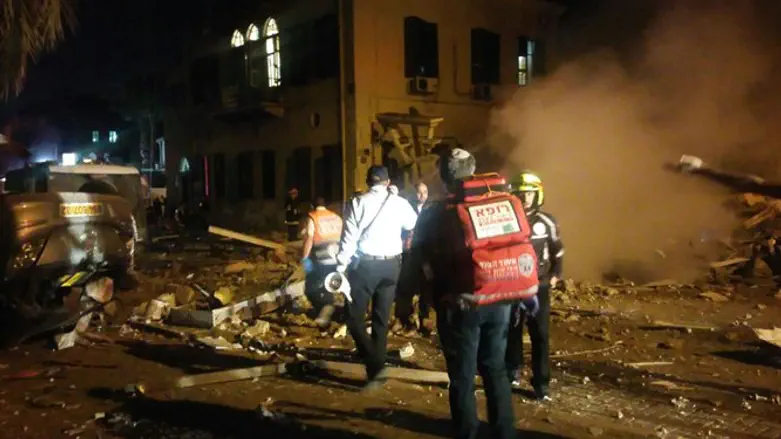
One of the most difficult things to do as a first responder is to prepare yourself mentally for the situation that you are about to walk into. There are so many variables and so many unknowns that take place in a chaotic scene such as the fire last night in Jaffa that claimed the lives of four people.
Ludman lives and works in Ra’anana and responds to emergencies with her fellow responder Dorit Mayerfeld who also lives in Ra’anana and is a Clinical Social Worker. “I was in the middle of exercising at home when I got the call, and I had no idea what to expect,” she said. “My partner and I went through scenarios in our head while en route to the scene in order to prepare ourselves for what we might have to face, but in the end, it comes down to training and being there with the people who are going through the traumatic experience. One never really knows what to expect except chaos.”
The Psychotrauma and Crisis Response Unit is tasked with providing psychological and emotional stabilization to the people at the scene of traumatic events who need their help. The goal of the unit is to provide on-scene psychological first aid known as PFA to those suffering from psychological or emotional stress following a trauma. This could be people who were injured, their families, or even witnesses and bystanders.
“When we go to a call people don’t necessarily know that they can use our help or need our help,” said Ludman. “Our first job is to locate those in need of our assistance and connect with them to let them know that we are there to help them and that they are not alone.”
“The woman told me that her husband and children were in the building next door when they heard the explosion and their windows blew out. While she sounded fine, from her physical mannerisms I could tell that something wasn’t right. She needed to be reassured that her needs would be met and it was my job to figure out what those needs were. Sometimes even when a person tells you they are okay, we need to make sure that they are functioning in the now,” Ludman added.
Ludman continued to recount her story. “Together with Dorit, I needed to calm the woman down a bit and reassure her that what she was experiencing was normal. That is when she told us that she was worried about things being stolen from her home since she no longer had any windows. She needed to be reassured that no one would steal anything so we took her to the police who gave her their assurance that their home would be protected. Once that happened she was able to relax and move on from the scene to go and help her family.”
Lior Eskenasy, a United Hatzalah volunteer emergency medical technician (EMT) and ambucycle driver was also one of the emergency responders at the scene in Jaffa yesterday. Eskenasy said how much the scene reminded him of another gas balloon explosion that took place a few years ago in Tel Aviv. “I don’t think I will ever look at a gas balloon in the same way ever again. It is shocking to me how much damage these things can do, and how many lives can be lost by one faulty balloon.”
After the flames were contained and emergency crews began to look through the wreckage. Some hours after the original explosion occurred, it was discovered that four people were killed in the blast. Many of the responders had already headed home before the bodies were discovered. As the accompanying trauma associated with the deaths can cause a new wave of emotional stress for the family members and friends of the deceased, as well as others who were at the scene, it too, was something that last night’s first responders had to deal with while responding to the scene of the explosion.