
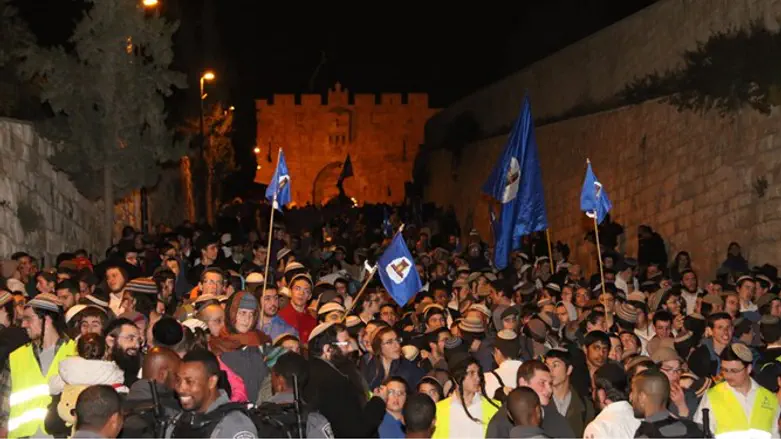
The "Sivuv Shaarim" (Circling the Gates) march around the gates of the Temple Mount, held every month for the past 16 years, is scheduled to take place this coming Sunday, the first day of new Hebrew month.
This month's march, which marks the beginning of the Hebrew month of Av, is of special significance, taking place during the Jewish period of mourning for the destruction of the Holy Temple. Last year, the First of Av Sivuv Shaarim march drew more than 1,200 participants.
But march organizers have expressed concerns that this month's event could be canceled due to recent Arab attacks on police in the capital, and threats of violence by Arab residents of Jerusalem.
Last Friday, three terrorists who smuggled weapons onto the Temple Mount murdered two Druze police officers. Following the attack, metal detectors were installed at the entrances to the holy site.
The Jordanian Waqf, which oversees the Temple Mount, objected to the installation of the metal detectors and instructed Muslims worshipers to avoid the site until the security measures were removed.
Arabs have rioted in eastern Jerusalem over the metal detectors since Tuesday. It is feared that the riots will convince the police that the march cannot be held for the safety of the marchers.
The monthly march has not been held in two months due to the Muslim holy month of Ramadan. Marchers had looked forward to the resumption of their monthly tradition.
The El Har Hamor association, which organizes the march around the gates, released a statement recently which read: "We congratulate the Israel Police and the commander of the Jerusalem district, Yoram Halevy, for placing the magnetometers at the entrance to the Temple Mount, which is undoubtedly an important step for the realization of sovereignty and security on the Holy Mountain. But this can't replace the march around gates during the month of Av, which publicly expresses the living connection and longing for the Temple Mount - the site of the Holy Temple. We expect the Israel Police to allow thousands of Jews to express these emotions [and allow the march to take place]."