
Ten years have passed. That summer, during the Second Lebanon War, I served as a platoon commander in the Golani Brigade, in Battalion 51. After weeks of fierce fighting in Gaza and Lebanon we had a brief respite. I could see that even greater battles were taking place on the faces of the soldiers, especially the grief in their hearts for their comrades who fell in battle.
The ceasefire did not last long. We were soon called back into Lebanon. The soldiers were ordered while preparing the navigational axis to get the equipment ready for the mission. A few hours later we were already driving through Lebanon in armored vehicles, heading for the combat zone near Bint Jbeil. I tried to hear what was being said on the radio despite all the noise around. I opened the hatch above me to stand and stick my head out to help find Bint Jbeil.
While I was talking on the radio I saw a huge fireball coming at us at very high speeds. There was a huge explosion and a wave of heat. An advanced anti-tank missile had penetrated the "armored" vehicle and pierced my body. If I had been sitting at the time I would not have had any chance of survival. Other soldiers were also injured. I tried to contact my commander on the radio, but there was no answer.
I was struck by many pieces of shrapnel and suffered many burns to my body. My right leg was partially severed and my left leg was crushed. I was treated on the field during the battle while directing the soldiers to return fire. After we reached the Israel-Lebanon border I was flown by helicopter to a hospital where I entered surgery, bleeding, but conscious.
I knew then, when I laid in the hospital seriously wounded, that I had to look forward. Living a normal life would be very difficult, but I never lost hope. I began a new life. I was forced to undergo 10 complex surgeries and was hospitalized for months. But it was precisely because of this hardship that hope was able to sprout. War, suffering, and injury are accompanied by a great deal of pain, but they also make possible unique experiences to change and grow from. The challenges of injuries require us to overcome our weakness, to discover our inner strength, and to connect more deeply to the roots of our nation.
Looking back, my personality was shaped in no small part by my command roles in the IDF, the fighting in Gaza and Lebanon, but no less during my rehabilitation. I learned in the hospital to greet a new world with wonder, especially the hospital staff which does everything for their patients. My doctors instilled in me the desire to enter into this enchanted world and to study medicine. Today, as a doctor, I hope that my personal experience with the medical team which treated me helps me care for my own patients with compassion and humanity.
You never know the depths of history and the relationships between the past and the present. But there is one story which really touched me. When I was hospitalized and undergoing rehabilitation in Tel Hashomer my grandfather, Issur LuBotzky, came to see me. He spoke of his days as a partisan during World War 2. As we sat in the rehabilitation wing, we were joined by Dr. Ziv-ner, the head of the department. My grandfather told us how he was injured in battle by a bullet to his right leg. He was rescued and brought back to the camp, but the wound became infected and he was running a fever. His condition was worsening.
There was a Jewish nurse in the camp who treated my grandfather with great devotion. She changed his bandages and got antibiotics for him. My grandfather recovered from the injury, and, despite the difficulty of the situation, immigrated to Israel. At the end of the story my grandfather looked at Dr. Zi-ner and told him, "Your mother is the nurse who took care of me in the woods." That is to say, the nurse who saved the grandfather's life is the mother of the doctor who treated my leg. From the Holocaust to redemption.
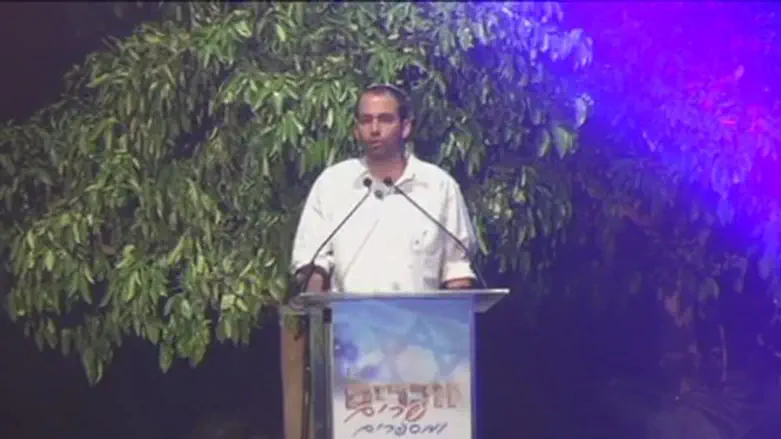
Dr. Asael Lubotsky was seriously wounded in the Second Lebanon War. Today heis a physician specializing in pediatrics at Shaare Zedek Medical Center in Jerusalem. Asael will participate in the main event of the day of recognition for Israel's wounded taking place tonight.