
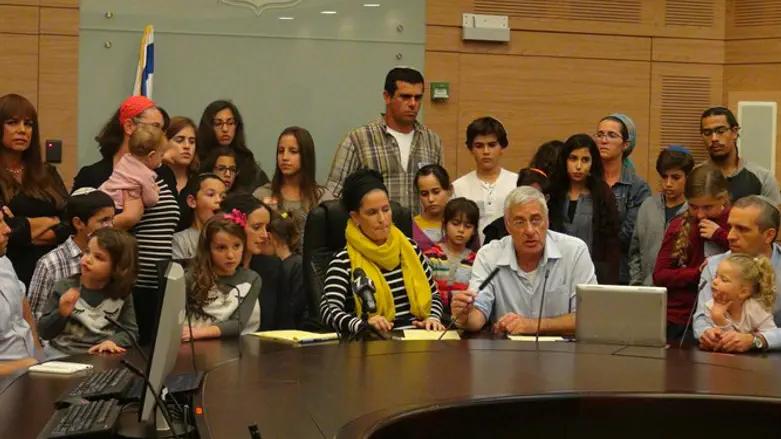
Residents of the nine homes in the town of Ofra which are slated for demolition came to the Knesset Wednesday to ask the government and the legislature to find a solution to prevent the destruction of their homes.
The residents held a press conference in the Knesset. Ester Brot, one of the residents, said: "Behind the name of Amona, Ofra, and Netiv Ha'avot, stand families and (real) people. To destroy a house is to destroy a family. I don't feel that justice was done here, not for us and not for those who claim ownership of the land."
"We think that with the law passed today, we can start a process that will lead to a solution. Demolition is not a solution." Brot said.
Tamar Alder, another resident of the houses which are slated for destruction, strongly attacked the demolition orders. "No one will benefit from this law of Sodom (evil law) to demolish these houses. A judgement of (King) Solomon says "It is not mine and it is not his." It will not be ours because they will destroy our homes. And it will not be theirs, because if they think they will get compensation-they will not get it. No one can reach this area. No one can live there and develop it back (to what it was)."
"Our request is the recognition of our civil rights." Alder continued. "I ask, where is the person who will take care of my civil and human rights? I know of all sorts of injustices in Israel for which there are large organizations and volunteers to help. But in our story the 'human rights champions'are silent and there are suddenly no rights and no one (to help). We ask that this injustice be stopped as soon as possible."
Shai Ben-Yosef, the chairman of the Ofra council, praised the Knesset's preliminary passage of the Regulation Law (aka Normalization Law) to normalize the Jewish communities in Judea and Samaria, and called on the government to adopt the recommendations of the Levy Report, which concluded that Israel is not an occupying power and that the Jewish communities in Judea and Samaria are not illegal.
"We expect that this legislation will not only regulate the 'settlements,' but that it will also prevent destruction and harm from befalling these families." Ben-Yosef said.
The land on which Amona and the nine houses in nearby Ofra are built was granted to various unknown friends by Jordan's king during the period after Jordan conquered Judea and Samaria, meant to be part of the Jewish state, in the 1948 War of Independence. Jordan was an occupying power from 1949-1967. The beneficiaries of the king's largesse never did anything with the land nor did they pay taxes on it. In 1967, when Israel retook Judea and Samaria, it did not assert sovereignty due to world pressure, instead ruling by IDF civil administration, leaving Jordanian law with regard to land issues in force. This is the kafkaesque situation in which Ofra's residents find themselves: paying taxes to Israel and putting their lives on the line in its army, while the homes they built with government support on land they had no way of knowing was claimed by anyone endangered by Jordanian law.