
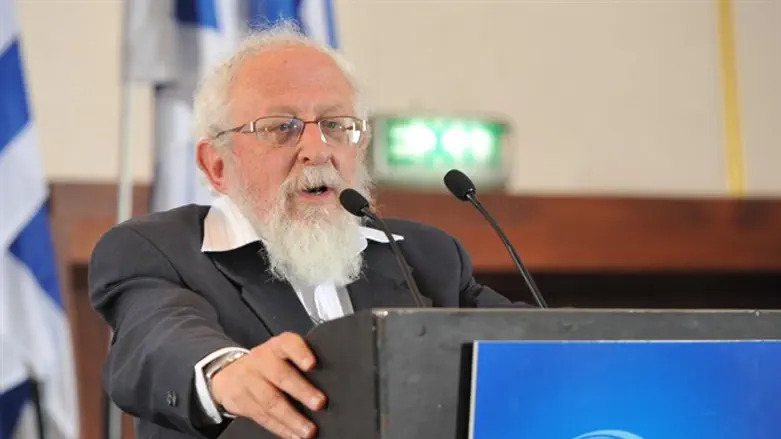
Rabbi Yisrael Rosen, head of the Tzomet Halachic institute which develops technological solutions to emergency requirements on Shabbat, was asked by A7 to discuss the Torah's viewpoint on the conundrum between the requirement of public Shabbat observance and the economic requirements of a Western country like Israel.
Rabbi Rosen was asked if it is even possible to strike a balance between the value of public Shabbat observance and the need of the country to minimize economic damage by performing public works on Shabbat.
He responded that, at the end of the day, it is impossible to view the economic requirement as a rationale for allowing Shabbat desecration as is permitted in life-threatening situations. Nobody intends to erase Shabbat observance for economic considerations, he said.
"The whole discussion is about taking into account essential requirements such as defense, medicine and other issues. Whatever concerns the economy indirectly affects life and death issues. Transport issues can lead to road accidents but it is absurd to say that economic issues are the topic; Shabbat has an economic price, and that is part of its definition.
"Even before the state was founded, economic issues arose, such as in agriculture, and in the cowsheds. These issues are economic and not security or medically related. There was a problem that Shabbat observers could not maintain economically viable cowsheds and therefore, they used gentiles and then used technology.
"However, when discussing national issues such as airplanes and trains, there is a price attached to these things and, just as one pays a price for other social requirements, one must pay for Shabbat as well."
"If the economic price will be very heavy, one could use Shabbat goyim on a national level," he added. "There are lots of foreign workers here and the supervision could be through Jews. In cases of heavy loss there are technological solution available and one can find similar solutions when the supervisors are Jewish and gentile workers are working under them."
Rabbi Rosen believes that this is the solution for a large number of essential national activities. However he rejects the idea of hiring a foreign contracting company to perform vital work on Shabbat, as this would meet heavy opposition from unions who would be concerned that these companies might also be favored for work on weekdays instead of Israeli workers.
Rabbi Rosen was asked if this issue was important enough to topple the coalition over it, as the Haredi parties are threatening. He replied in the negative, since in a situation where businesses are open everywhere on Shabbat it would be unseemly to topple the government over this issue. He maintained that in a situation where Shabbat is trampled in the private sector both for business and for entertainment purposes, it would not be legitimate to topple the coalition over the upgrading of train tracks. "One cannot topple the government over everything," he concluded.