
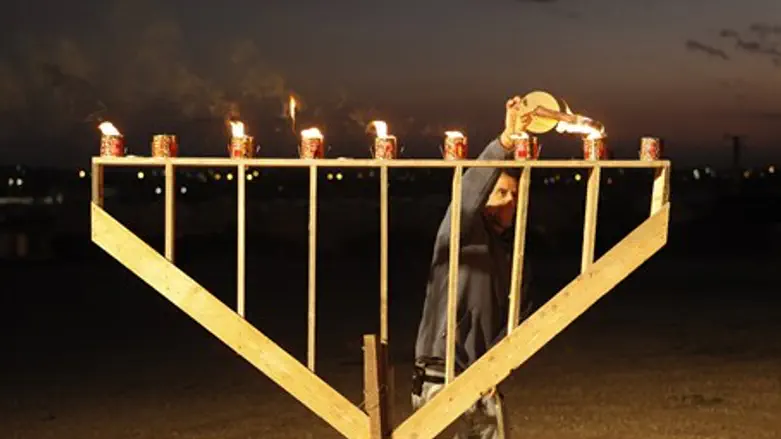
It was last Sunday evening, the first night of Hanukkah, and we marked the occasion in a real yet contemporary way. The speaker was Israel’s ambassador to the United Nations, Danny Danon. The newly appointed representative at the UN said that his professional life as a diplomat representing Israel is today’s real-life Al Hanissim.
“You have to walk the halls and attend sessions at the UN in order to recognize the light projected by Israel and the impact it has on the darkness that is the United Nations,” Danon said.
So you see we do not have to necessarily reflect upon the way things used to be in ancient times in order to appreciate and even experience the miracle of Hanukkah. It’s right here before us, impacting our lives.
For the Maccabees, it may have been a military challenge more than today’s diplomatic interfacing that takes place in what is referred to as Turtle Bay on the East Side of Manhattan. But that seems to be the destiny of Israel—a fate that is articulated with profundity at this time of year, which we express in tefillah.
It is not too much of a stretch to say that the Al Hanissim prayer has a great deal in common with events that are currently playing themselves out as it affects Israel and the international community. Today Israel is strong and somewhat independent. At the same time, while the country is militarily able to defend itself, leads the world in high-tech innovations, and is about to become energy independent, they also display a dependency and even neediness on some levels.
Compared to the status of the Jew in the world 75 years ago, we can acquire a finer understanding of the prayer that reflects on the triumph of the Maccabees against the Assyrian Greeks, thanking Him for “delivering the mighty into the hands of the weak, the many into the hands of the few, the impure into the hands of the pure, the wicked into the hands of the righteous, and the wanton sinners into the hands of those who occupy themselves with your Torah.”
Perhaps the lines are not as sharply drawn today as we imagine they were a few thousand years ago. The foundation and the outline, however, seem to be starkly similar to the events of yesteryear. The attempt to denigrate and even destroy Israel in whatever form possible continues to be relentless.
This unbalanced contrast has become even more noticeable of late. The uptick in terror attacks around the world seem to lack any understanding or acceptance in the world’s mind unless it can be attached or at least associated with Jews and Israel in some fashion.
When the theater was attacked and 130 people were killed in Paris, it was immediately noted that sometime in the past the Bataclan Theater was owned by Jewish businessmen. For a few hours, it seemed plausible that this was the rationale and explanation for the terror attack from ISIS operatives. But then when it was learned that the theater had not been owned by Jews for quite a number of years, it was discovered that the rock group on stage at the time, “The Eagles of Metal Death,” had performed in Israel in July 2015. That must have been the reason, some explained.
At the end, it became clear that the Paris attack had nothing to do with Jews or Israel. It was secular Europeans that the terrorists were after.
Last week in San Bernardino, California, it was inexplicable how someone could burst into an innocuous holiday office party and murder 14 people while wounding another 21. But wait, there was a man there who came to work in a yarmulke on some occasions and even sometimes wore a tallis. It was soon discovered that he was what was called a Messianic Jew—except that he wasn’t Jewish. But he was conservative and posted critical comments about Islam and ISIS on his Facebook page. He might have been the reason for that attack. It might have been that big red yarmulke he liked to wear. Then again, the attackers may have just hated America and wanted to kill whomever they could.
Now Donald Trump, who cannot reduce or minimize the amount of media attention he gets no matter how hard he tries, comes along and announces that in his opinion, the U.S. should cease to allow entry into the country of any Muslims until, as he says, “We figure out what’s going on here.”
America is both up in arms and confused about the leading Republican presidential candidate’s stance on the issue. Does Trump mean all Muslims? What about those out of the countries who are citizens and want to return? Will they be stuck outside the country? And what happens with Muslims in the U.S. military who are serving overseas but want to come home for the holidays or on leave? And what about those who are married to Muslims, have Muslim names, but are not Islamic? What about those who are Muslims with Americanized names? And finally, what do we do with those who have names that sound Islamic but are not?
Rabbi Abraham Cooper of the Simon Wiesenthal Center in Los Angeles said that in his estimation it is a big mistake to “place all Muslims in one basket.” He said in a telephone conversation with this writer on Tuesday that as Jews, we should be especially sensitive to witnessing an episode like this when we know what it is like when we are the targets of this type of treatment.
Leading up to the Trump comments, in his address from the White House Sunday night, President Obama said that even though America was the target of what might well have been an ISIS attack in California last week, the U.S. fighting ISIS would encourage and strengthen ISIS. So we are better off not fighting them.
Additionally, the president said that it would be wrong to take any of this out on all Muslims and he is right on that count—that should not be done. At the same time, 56% of all anti-religious attacks in the United States are directed at Jews. Only 13% of similar-type attacks were directed at Muslims. Still, never did the president, the attorney general, or any official see fit to comment about anti-Jewish assaults or violence.
This convoluted and distorted way of thinking leads to statements like that of the Swedish prime minister, who said that knife attacks on Jews in Israel are not terrorism. And that was accompanied by his foreign minister commenting that Israel was executing Palestinians. Also, we can categorize under the same heading Secretary of State John Kerry’s comment a few weeks ago about there being “legitimacy” and a “rationale” for some terror attacks while there is none for others.
So amid all the nonsense and not too well-thought-out pronouncements, at the end of the day how are we supposed to deal with ISIS and the terror they seem to be bringing to our shores?
Rabbi Cooper of the Wiesenthal Center says that as Jews, it is incumbent upon us to find common cause with Muslims who live and work amongst us. He points out that one of the San Bernardino SWAT team members that killed the husband-and-wife terror team was a Muslim of Iranian descent. It is irresponsible and ridiculous to function with the impression that every Muslim is dangerous or that he or she poses a risk or danger to those not Islamic.
That is why, he says, the Wiesenthal Center had to speak out against the Trump statement. His solution is for the responsible military parties fighting ISIS to target and eliminate the leadership of the extreme crazed group.
Today it is the extremists who are the few, while those with sane and responsible positions are indeed the many. But the political correctness today serves as an obstacle to getting the job done. That needs to change—but that might take a miracle.