
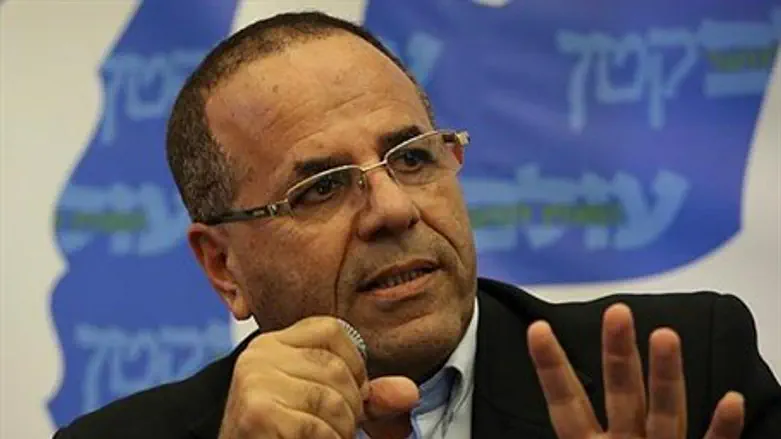
The best way to fight ISIS, according to Druze MK Ayoub Kara (Likud), is for Israel to ally itself with other countries in the area that are trying to keep the Islamist terror movement at bay. And the best country in the region to ally with, said Kara, is Jordan.
This, despite the ongoing anti-Israel comments, resolutions, praise of terrorists and other actions taken by Jordanian government officials against Israelis in recent months.
“Strengthening ties with Jordan is the best answer to the ISIS threat,” said Kara on Tuesday at a conference discussing opening a new direct route in the southern Dead Sea region between the two countries. Among the ties Kara is interested in strengthening are economic ties.
Last year, imports from Jordan to Israel totaled $380 million, up from $160 million in 2010. However, exports from Israel to Jordan have been falling – from $200 million in 2010 to $110 million last year.
Opening a new border crossing will allow more Jordanian workers to be employed in Eilat and in agricultural and manufacturing plants in the south, taking the place of illegal foreign workers who generally take these jobs now. In addition, giving Jordanians access to those jobs will help reduce poverty in that country, as well as make it easier for travel agencies to put together packages that will appeal to more tourists interested in visiting both countries, Kara said.
However, Jordan has not always apparently shared Kara's warm feelings about the relationship between the two countries. In recent weeks, Jordan has castigated Israel for defending itself against Arab terror, saying that it had “crossed a line.” Hours after Arab rioters attacked Israeli security forces at the Temple Mount in early October, Jordan criticized Israel over security forces' conduct in reaction to the riots.
"The forces of the occupation ... prevented religious officials entering (the compound) and cleared it of all Muslims, while at the same time enabling Jewish extremists to storm it, and pray with security forces protection," government spokesman Mohammed Momeni said in a statement quoted by AFP. He called on Israel to "stop its devastating campaign against the Al-Aqsa mosque, religious officials and worshipers," slamming "police... firing bullets and bombs inside the compound, which injured dozens of people.
And on Monday, a teacher who taught a beginners' Hebrew course at Jordan's Petra University was fired from his post after he told his students that the Hebrew language would help them understand Israeli culture. One student, Ayman al-Ma'mun, organized a Facebook campaign for the teacher's dismissal; Petra University could not withstand the pressure, and fired the teacher two days later.
Former Israeli ambassador to Jordan, Oded Eran, noted that this was not an unusual occurrence from what he saw while he served in the post. "Most of the professional associations - journalists, doctors, lawyers - all of them [in Jordan are] anti-Israel," he said, adding that some of this has to do with the Palestinian population's predominant presence in Amman. The majority of Jordanians citizens and residents are in fact Palestinian Arabs.
Nevertheless, Kara sees a future in building closer ties with Jordan. “Preserving positive relations between countries that want to live in peace with us and see eye to eye with us on regional threats is a primary security and political policy plank for Israel,” he said. “In this case, it is Jordan that can play a role in strengthening Israel's ties with other countries in the region, and help turn Israel into a regional economic power."