
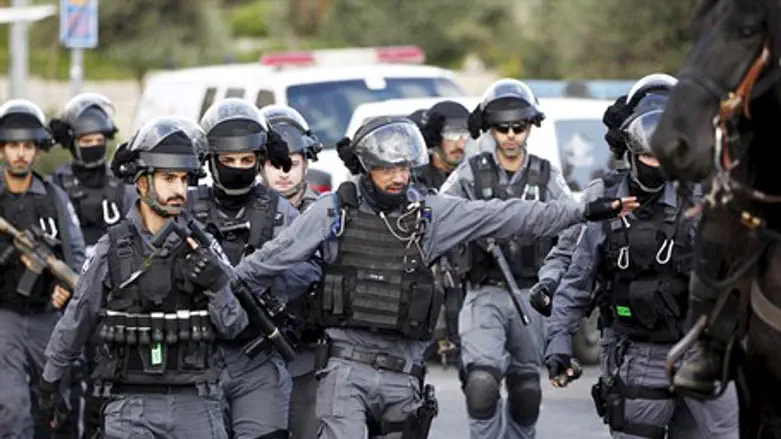
Police officers of past and present defended Israeli security forces Friday, amid controversy over two separate incidents this week in which people were killed during attacks who were not actually terrorists.
"Let's not call them 'trigger happy' straight-out," a current senior officer stated to Channel 2, on condition of anonymity. The officer is familiar with the details of the latest incident in Jerusalem, in which a Jewish man was shot by security forces after being mistaken for a terrorist. "There are cases we see as problematic. For us, every man holding a weapon has a great responsibility when it comes to deciding to take a life."
"It requires he checks himself 20,000 times that he's making the right decision, and using that [right] efficiently and professionally," the officer added. "You have to remember that we work in urban scenarios; in places like these it's possible to do more harm than good."
"This is a very sensitive period," another officer added. "Everyone is tense, any random argument or a fight can seem like a terrorist incident."
"This is a time of great caution, but there is a very heavy responsibility here, we are deployed all over the country and must act immediately in every event."
It is important to emphasize that an initial investigation of the incident revealed that the soldier who shot and killed the man acted according to protocol - he responded by firing only after being convinced that this is a terrorist and after he tried to grab the gun of his friend, and used against the suspect his personal weapon, not his automatic weapon.
More murky are the circumstances surrounding the death of Eritrean migrant Haftom Zarhum, who was shot to death and then beaten after being mistaken for a terrorist during the Be'er Sheva shooting attack Sunday. Recent developments have revealed that Zarhum died from being shot by security forces, not from the beating he sustained by panicked bystanders.
Former officers speak
"It's the price we pay, we are in a very complex situation," retired police commander and former MK David Tzur reflected. "There can be no mistake, we are in a volatile situation, and it will happen in the future that people will recognize the wrong person [as the terrorist] and will act wrongly."
"However, there is nothing we can do about that," he said, excepting "sharpening the rules of engagement and training forces to anticipate such events."
"This police and border police work, it requires skill," he added, noting that he is "not a fan" of the IDF taking over civilian patrol work during these times. "The soldiers are targeted more often by hostile enemies, and have less work with the civilian population, but it can also happen to police forces on the ground."
Former Jerusalem District Commander Aryeh Amit was also not quick to condemn the incidents as shoddy police work.
"Without a doubt this is the price we pay," he said. "It is not the first case and unfortunately it will not be the last, but there is no choice but to pay it."
"We are in a period that we are all tense," Amit added. "We must not be frightened of an error or two."
"In total so far, we see that the involvement of both the security personnel and civilians led to the terrorist being neutralized until eliminated. When the mistake is made by the security forces it bothers me more that it's a professional failure."
Amit agreed with Tzur that the IDF presence is "creating more panic," rather than less.
"I think leadership is partly to blame; they're not doing a good job reassuring the public," he opined.