

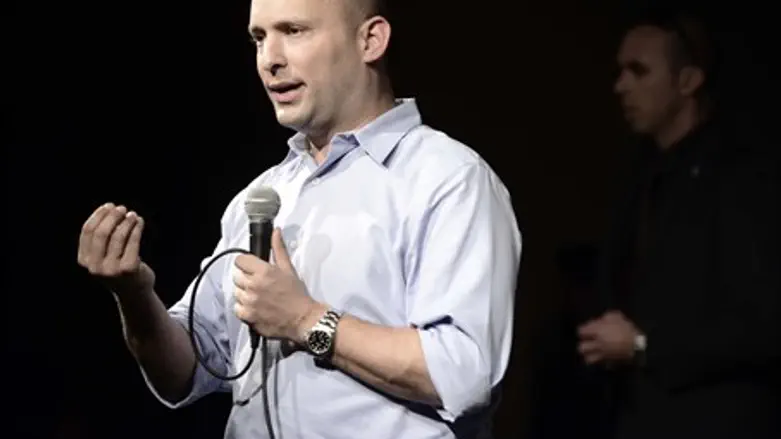
Jewish Home saw a disappointing 33% drop in its representation last night, but it is not all disappointment by any means for the party. For the first time in years, one of the two mainstream parties has explicitly stated there should be - in fact, will not be - a Palestinian state under their watch.
Did that draw in the Anglos?
It is more likely that the Prime Minister pressed his advantage as the head of a large party that brought Anglos - especially Americans - to choose him in the end, explains Jeremy Man Saltan, head of the Bayit Yehudi Anglos Forum.
“His statesmanlike persona was definitely a factor. The way he talks in general also appeals to Americans. Based on what we know of Anglos, we know hasbara (public relations) is a big focus of that sector and things like his speech resonated.”
There was the campaign to promote the idea that without a large mandate, Likud would not be selected to form the next government, which Mr. Saltan feels might have taken advantage of some people's unfamiliarity with the flexibility President Reuven Rivlin actually has in choosing the leader of blocs instead of parties to put together governments.
But also, there was the "statesman-like persona" that Bibi projected the last several weeks that made him look to Americans, well, Presidential.
"That speech was a deciding factor for much of the segment. His campaign manager, Aron Shaviv was also an Anglo. He leveraged the personal relationships he had with English-speaking media."
"There was a push in the campaign to move toward that demographic, which would not have happened had Netanyahu not had an Anglo in such a high position."
Anglos are not considered "bloc voters" and will distribute their votes among different parties. But considering Likud picked up a clear 25% of the national vote, a bloc of people from a specific background would still demonstrate an opportunity for a party even if they provide only a slightly better percentage (say 35% for Likud) than the national vote did.
On what might have hurt the Jewish Home itself, Arutz Sheva asked if the Eli Ohana episode was really as important as the formation of the Yachad faction, which occurred in the same week.
"There was the Eli Ohana controversy, but only at first. Remember he did not even make the list. He was gone within a few days."
"I think the establishment of Yachad definitely had an effect. You suddenly had this other option working in a specific area of the country with a specific group that was campaigning for Religious Zionist votes in a way that other parties weren't."
Despite those two factors, Mr. Saltan returns to the issue of Netanyahu's campaign.
"He convinced a lot of people to vote strategically because of their misunderstanding of the system. It was connected to Likud campaign that had them not running on issues or a platform or a list of accomplishments. They ran on the premise that people needed to vote strategically, not ideologically."
Whatever the different conservative ideologies were for voters and despite whatever effects the Ohana episode and Yachad's unification jointly had on the Jewish Home faction, it was the 'sure thing' that Likud offered voters who wanted to anchor a right-wing government.
Saltan still sees any government having a likely composition of Jewish Home, Kulanu, the haredi parties and Yisrael Beytenu. When asked if party members were concerned by the demands of Shas and UTJ, which might contradict the platform Bennett pushed in the previous government, he thinks that they can only go so far.
"Shas and UTJ will have their demands and we'll see what those are," said Mr. Saltan, who emphasized this reflected his own personal view of the situation and not necessarily the party's. "I don't think it will be so much about turning back the clock as preventing these initiatives from going further."
"The probable question is, 'What can Kahlon, Lieberman and Bennett can live with?'"
"It will be very interesting to see who Bibi signs his first deal with, but we are getting very ahead of ourselves (emphasis by Mr. Saltan). That process only starts next week."
The silent victory for Jewish Home might be in the effect their rejection of the Two State Solution has had on the electorate. Not only did the Prime Minister flatly reject such a state in the final day of the campaign, but centrist parties like Kulanu and Yesh Atid are open about their own distrust for Mahmoud Abbas regardless of their inclinations to a Palestinian state or not.
As for only getting eight mandates themselves, Saltan is not at all worried that the single-digit show in the polls will push Bennett down the totem pole.
"Bayit Yehudi was the only party to endorse Bibi before the election and Bennett the only minister to accompany him to the US. Bibi said Bennett will be a senior member of the next government, so of course this is a joint victory.
"There is less importance to the number of seats regarding whether or not Bennett will be holding a senior portfolio."