

The White House said Wednesday that despite reports to the contrary, the US was not cooperating with Iran in the battle against ISIS.
A spokesperson commented “we will not cooperate with them,” referring to reports earlier this week that the US had not opposed Iranian attacks against the ISIS terror group, which has captured large swaths of territory in Iraq and Syria.
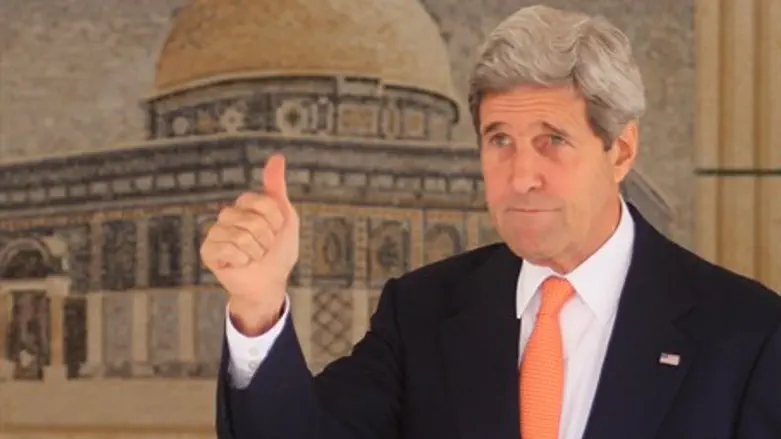
With that, US Secretary of State John Kerry said on Wednesday that “any action against ISIS is welcome.”
Speaking in Brussels, Kerry said that the US was not working with Iran on fighting ISIS, or anything else. But, he said, "If Iran is taking on [ISIS jihadists] in some particular place... and it has an impact, then it's going to be net effect [that] is positive.”
Earlier this week, news website Huffington Post quoted a US official as saying that Iran is taking part in attacks against ISIS, apparently with at least the consent of the United States.
"We are aware of that. I wouldn't say we're necessarily concerned with it -- we kind of have our eyes on it," the website quoted the official as saying.
One reason for that, the official said, was that Iran was bombing ISIS targets near its own border, away from where the US and its coalition partners were operating.
The comments, according to the website, confirmed earlier reports that Iranian planes had been seen in the skies over Iraq. The planes were seen in footage broadcast by Al-Jazeera last week. According to the reports, Iran has been actively engaging ISIS since at least the summer.
It's unlikely Iran would be able to operate in Iraq without the US being aware of it, given the large American deployment in the country, the official said.
"We are there pretty heavily in the air if you include [intelligence collection], so just looking at those facts we have a pretty good picture of what's happening in Iraqi airspace. We would not be operating in Iraq without having a clear picture,” the Huffington Post report said.
Last week, Muslim clerics of both the Shi'ite and Sunni sects from about 80 countries gathered in Qom, Iran in order to work on a strategy to combat extremists, including ISIS. As a Shi'ite state, the US official said, Iran felt threatened by the radical Sunni group, and could be expected to continue its campaign as long as that threat persisted.