
"Israel shouldn't be afraid of anything," Professor Eyal Zisser, head of the Department of Middle Eastern and African History at Tel Aviv University, told Arutz Sheva.
Arutz Sheva interview Professor Zisser at the World Summit on Counter-Terrorism, The International Institute for Counter-Terrorism's 11th International Conference, Interdisciplinary Center (IDC), Herzliya, which took place this week.
"King Abdullah of Jordan said Israel should be afraid," Zisser said referring to remarks made by Abdullah II on Monday. "We are not afraid. We are a very strong state."
At the same time, Zisser did note the increased volatility and radical shift in the region due to the Arab Spring could impact Israel's diplomatic status quo, saying it could negatively impact the 1979 Egypt-Israel Peace Treaty.
"What we see here is a clear process," Zisser said. "Very strong demonstrations against Mubarak, then the revolution came to a dead end, and now they are looking for another target.
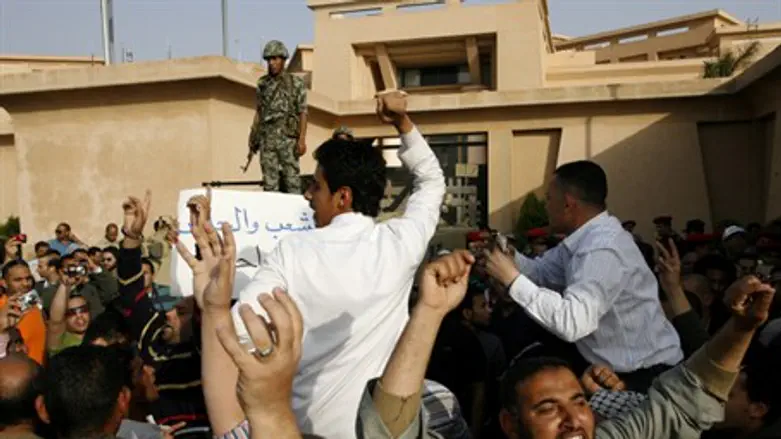
"We see in Egypt how the street dictates to the [military] council's its moves. The street now controls Egypt," Zisser added.
Zisser described Turkish Prime Minister Recep Tayyip Erdogan as immature, saying his rhetoric could have consequences Erdogan does not intend.
Its "a very dangerous development, taking into consideration the nature of the Turkish leadership now days, and the prime minister [erdogan]... how emotional he is, how immature and irresponsible he is... where his rhetoric can clearly lead," Zisser said.
"We've seen it in the past in previous cases. Extreme rhetoric... radical rehortic can lead to radical moves even if, at this moment, he is not interested in a conflict with Israel," Zisser said.
Zisser dismissed the assertion advanced by many, including opposition leader Tzipi Livni (Kadima), that the upcoming Palestinian Authority statehood bid at the United Nations was brought on by the Arab Spring.
"The Arab Spring didn't create anything new... the anti-Israel sentiment, the Turkish policy, the Palestinian moves… It puts it in a different perspective, but it doesn't change the entire picture."
He also dismissed the notion that the Arab Spring would bring democracy to the region.
"Maybe some of those who demonstrate in streets of Tunisa and Egypt, what they had in mind was to introduce democracy, but clearly that's not what we're up to now in the Middle East," Zisser said.
"What we see is a very traditional society rooted in the past and unfamiliar with Western democratic ideas," Zisser explained. "I think what we'll see is not necessarily democratic regimes, but popular regimes."