
Although it is thought of as a relic of Israel's socialist past, the kibbutz has been undergoing something of a revival in recent years – with the emphasis this time on social action. The Dror Israel movement has been one of the main engines behind this revival, establishing kibbutzim mostly in urban centers with underprivileged populations.
Last week, one of the organization's kibbutzim, Eshbal, was recognized by the British Ambassador to Israel, Matthew Gould, for its efforts to integrate disadvantaged youths from troubled backgrounds – especially Ethiopian immigrant youth – at its school in northern Israel.
“Today's kibbutzim are more about instilling Zionism and values in Israeli society,” says Dror Aboudi of Kibbutz Eshbal. “One of the things we decided in 1998 when we established Eshbal was to get involved in communities in the area that need help.”
To that end, the kibbutz set up programs in nearby Carmiel, where large numbers of disadvantaged families from the Russian and Ethiopian communities live. “We also have a special program where we work with youths from the Arab villages in the area, teaching them responsibility and democratic values, to enable them to better fit into Israeli society.”
But the highlight of Eshbal's activity is its school and dormitory, where hundreds of students who never succeeded in school get a second chance. “The kids who come to our school are the ones who got thrown out of other schools, and the ones who have been roaming the streets for years, staying away from school or any positive framework.”
It's rough going – not all the kids were happy to be there, at first – but with time, they grew acclimated to the environment, thanks in no small part to the patient attention given by Eshbal staff to the students. “At first we hired top teachers to teach the classes, but the job proved to be too challenging for many of them, who quit. We decided that the only way to succeed was to put kibbutz members in central positions in the school.”
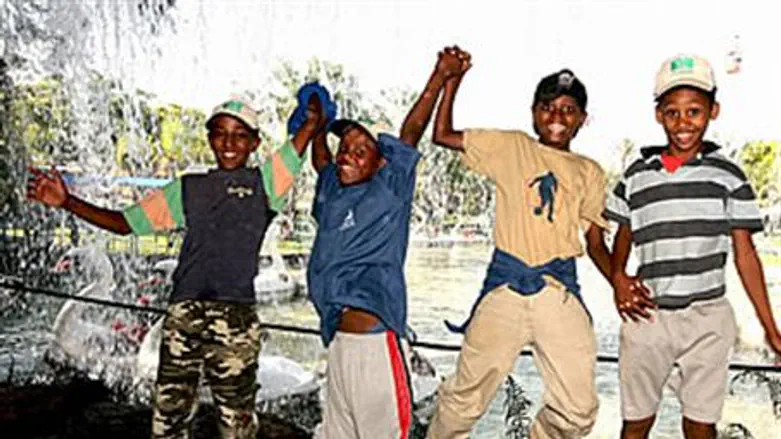
About two thirds of the students are from families that immigrated to Israel from Ethiopia – because this group has the greatest need for help, says Aboodi. “We found that many of the youths had a very hard time being the bridge to Israeli society for their immigrant parents on the one hand, and fulfilling their own aspirations on the other.”
The program includes classes, afterschool activities, leadership workshops, class trips – in short, everything students at a mainstream school would receive. “The progress has been amazing,” says Aboudi. “We have graduated four classes, with nearly all the youths going into the IDF, and some are already hitting the workforce. Many of our students have not been to school for years, but within a year we were able to bring their level up to the extent that they were able to take tests at the tenth and eleventh grade level, just like their peers elsewhere.”
It's this selfless activity with which Ambassador Gould decided to get involved, sponsoring a special festive night for the school at his home, after learning about Eshbal from the British UJIA organization. Speaking at the event, Gould said that the kibbutz “helps people from all communities, from all backgrounds in Israel. It’s an approach that I believe were the founders of Israel still with us and were they to visit Eshbal, they would immediately applaud.
"And I say to people when I have the chance, that if you believe that the Zionist vision is dead, if you believe that that idealism has in any way seeped away from the modern Israel, let me take you to Eshbal, let me show you what an inclusive Zionist vision looks like.”