
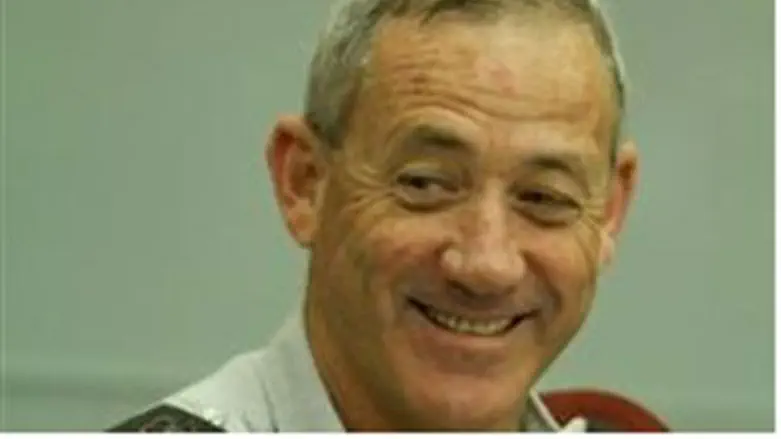
IDF Chief of Staff Lt.-Gen. Benny Ganz appeared before the Knesset Foreign Affairs and Defense Committee on Tuesday, relating to the Itamar murderers and the change for the worse in the scope of the dangers facing Israel.
Committee Chairman MK Shaul Mofaz (Kadima) congratulated the COS on his recent appointment, “Ganz is a worthy man", and qualified this by saying "but I have many reservations about the way he was appointed.”
Ganz addressed the Itamar murders at the meeting, saying, ”the killers aren’t human”. Ganz was asked by committee members if they should get the death penalty, and he responded, ”I won’t say anymore on the subject.”
On the Iranian threats Ganz said, “Iran is a major threat not only due to its intention to develop nuclear weapons, but also because of its ideological and military support of radical factions.
Ganz related to the Middle East upheavals, saying that the scope of threats on Israel have gotten wider, from knives to nuclear weapons.
“There is present and future instability in the Arab states. The changes can be potentially positive, particularly when the leader is threatened by the people in the streets,” he said.
On the changes in Egypt he said, ”Egypt is attempting to stabilize its economy and security situation, as well as its regime. Egypt is not a threat to Israel. We have peace with them, and it is an Israeli prerogative to reinforce this peace. On the other hand, it must be stated that Egypt is not as stable as it used to be, and therefore the level of our security guarantees must be higher than before. No doubt, we are concerned about the Sinai situation.”
As of this morning, Egyptian security forces were in hot pursuit of 400 Al Qaeda terrorists in the Sinai desert.
The COS related to the fence being constructed in the South. “The fence provides a solution for the problems of border infiltration and weapons smuggling. We will complete the fence construction by the end of next year, earlier than previously projected.” He added, “There have been 3114 infiltrations since the beginning of the year. Of them, only 140 infiltrators were sent back over the border.”
On Syria he estimated that “Assad does not know how Syria will look this week or the next. This insecurity disturbs him as it does us. There have been over 1200 killed in Damascus since the beginning of the uprising. The chances that Assad will attack Israel to ease his pressure are slim.” He added that “there is Hizbollah influence in Syria.”
“There is no humanitarian crisis in Gaza, in any way, shape, or form.” Clarifying, he explained: “In fighting terrorist organizations that attack from civilian locations we will have to use much more force in the next conflict, even if this extracts a high price from the other side. In this kind of combat we will have to provide humanitarian aid.”
Ganz related to Ultra-Orthodox IDF enlistment, and the phenomenon of army dropouts. “The number of Ultra-Orthodox soldiers in designated programs should be increased. The IDF dropout level is at 12%. I aim to reach a single-digit percentage.”
In conclusion, Ganz said, “I am willing to accept the great challenge placed before me, particularly in this sensitive period of time. Army professionalism is important to promote, but it is just as important to invest in values, where there is no room for compromise. I want to develop a regimen in the IDF where I hear what I need to hear from my people, and not what I want to hear. I will then be able to reach a decision, and demand it be carried out.”