
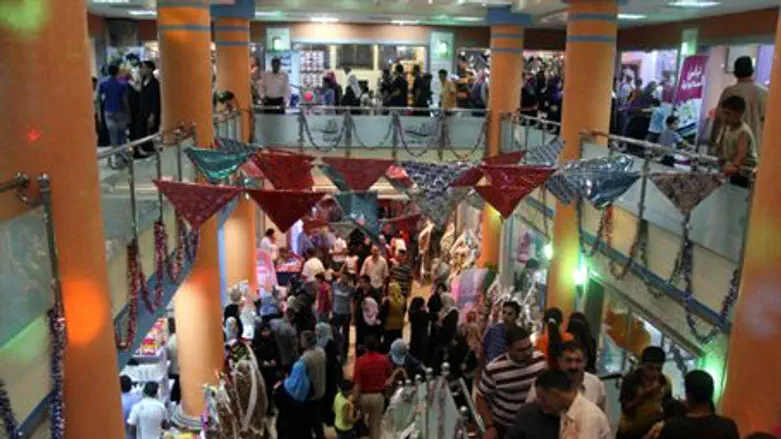
A delegation of Palestinian Authority business owners from Judea and Samaria entered Gaza through the Rafiah Crossing Thursday for a separate unity meeting with their counterparts in Gaza's private sector.
The point of the meeting was to discuss ways in which to restore infrastructure in the region, much of which was destroyed during Israel's counter terrorism Cast Lead mini-war, December 2008-January 2009.
Mohammad Mustafa, chairman and CEO of the Palestine Investment Fund, and Abdullah Al-Afranji, manager of the Al Quds Bank in Ramallah and a member of the Fatah Central Committee participated in the delegation.
Plans for expansion of the electric company, desalination facilities, a new airport and a seaport were among the projects discussed, according to media reports.
Mustafa pledged $200 million towards the effort and urged that others do so as well. In addition, he said up to $5 billion in special funds were promised to the PA by donor nations for Gaza's reconstruction.
However, he added, one of the biggest challenges the new PA unity government will face will be the issue of convincing donor nations to make good on their pledges.
And therein lies the catch: most donor nations have agreed to continue the flow of funds to the Ramallah-based government on condition it does not reunite with the Hamas terrorist organization -- unless Hamas agrees to formally recognize Israel's right to exist, renounce violence and uphold previous PA agreements with Israel.
Hamas has repeatedly reiterated its unwillingness to do comply with these conditions, set by the Quartet of peacekeeping nations -- the U.S., Russia, the European Union and the United Nations.
As for upholding previous agreements,the planned reopening this Saturday of the Rafiah Crossing without deployment of the EU observers is solid proof that both the PA and, for that matter Egypt is a direct abrogation of the November 2005 agreement negotiated by the U.S. between Israel and the PA.