
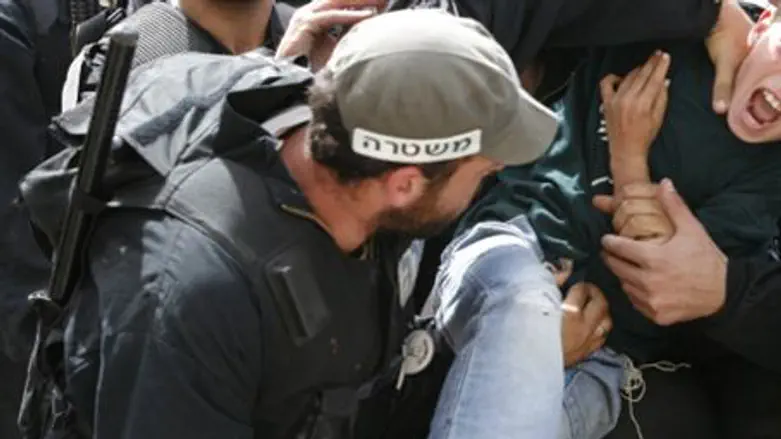
In a report largely overlooked by the media, Jerusalem Magistrates Court Judge Hagit Mack-Kalmanovitch acquitted Hevron resident Yifat Alkobi last week of assaulting an Arab boy in 2005.
At the same time, legal rights activists in Judea and Samaria say the police have recently made many arrests with no justification.
In the Alkobi case, the judge criticized the police for running a deficient police lineup. She also said the police chose to accept the testimonies of the complainant and his friends – even though they were contradictory – while ignoring the eye-witness testimony of the Jewish residents.
Alkobi says she has been singled out for persecution by Hevron police and others. This is likely due to a 2007 video, circulated by the B’Tselem human rights organization, showing her yelling and cursing an Arab neighbor.
More Arrests
In other “settler” news, large special-unit Yassam police forces raided the Mitzpeh Avichai hilltop neighborhood this morning, arresting one resident. A lawyer for the Honenu civil rights organization is investigating the matter. Mitzpeh Avichai is located just above Kiryat Arba, adjacent to Hevron in central Judea.
Last night, a young resident of Gilad Farm (Havat Gilad) was arrested – for the second time in two weeks. Attorney Yehuda Shimon of Honenu, who also lives in Havat Gilad, arrived at the Ariel police station in order to meet with the youth, but a police officer told him that he had issued an order forbidding the arrestee to meet with a lawyer. After his previous arrest two weeks ago, a judge ruled that he was being held for no reason and ordered him released unconditionally.
Honenu head Shmuel Medad told Israel National News, “In the past two weeks, there have been no fewer than eight cases in which Jewish residents of Judea and Samaria have been arrested and then released hours later without a shred of evidence against them. This is a cynical abuse of the clause enabling the police to make arrests and hold people without evidence for up to 24 hours.”
Medad also decried the use of “blanket gag orders,” preventing the publication of cases such as a recent one in which arrests are made and judges agree to police requests to extend custody without any evidence.