
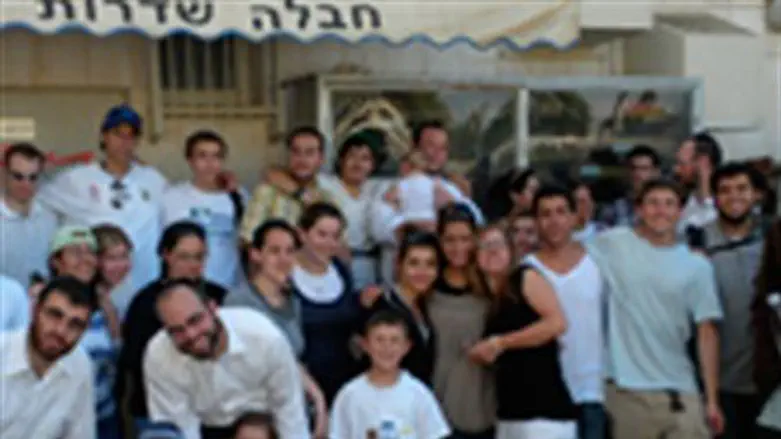
For the many students who visit each year, Israel can be a life-changing experience – and in the case of students who visit on Yeshiva University's “July in Jerusalem” program, those changes could include something as basic as getting to know what a mezuzah is, making a lifelong commitment to wearing tefillin, or even breaking up with a non-Jewish fiancee.
All those changes, and more, came about in the lives of students who participated in the program, says, Shoshana Schechter, Director of YU's Basic Jewish Studies Program for Women and one of the coordinators of the program – and the students couldn't be happier. “This unique program has truly been transformational for all who have participated,” she told INN. “Students begin to see themselves as part of the chain of Jewish history and continuity, they realize that they are an integral part of the Jewish community and are inspired to continue learning, growing and developing their Jewish identities.”
Although Yeshiva University is generally known as an Orthodox institution whose students hail from observant families, that's not necessarily the case, say Schechter. “Students have various reasons for choosing YU, and not all of them have strong Jewish backgrounds. Many are still forming their religious identities only now, in college.” In addition, she says, the program also accepts students from other universities, many of whose connection to Judaism is tenuous minimal.
The program runs during the summer intersession, for just a month – but aims to give participants the full-on experience of a year in Israel. “The students who participate never had that post-high school year in Israel to strengthen their identification with Judaism, the Land of Israel, and the Jewish people,” says Shechter. “We try to give them that experience in compacted form, with learning programs, trips, chessed projects to help the needy, and meetings with important personalities. Instead of a 'gap year' between high school and college that many Yeshiva graduates take so they can learn in Israel, this is a 'gap month' program."
Program participants attend daily morning classes, including Hebrew Ulpan, Bible, Jewish Philosophy and Jewish Law, taught by respected rabbis and teachers, says Shechter, and spend their afternoons volunteering at hospitals, orphanages, soup kitchens, food distribution centers and various terror relief projects in Sderot, and touring Israel’s most famous sites. Activities include kayaking down the Jordan River, exploring ancient caves, hiking, snorkeling and spiritually uplifting Shabbat programming in the Old City of Jerusalem.
For some students, a month - “the tip of the iceberg,” says Schechter – just isn't enough, and each year (this year's program will be the fifth), a number of students stay for a semester, or even for a full year. “That's a result we're always happy with, and we help them find a program and adjust to student life in Israel,” she says. “Many of the participants are new to Jewish life altogether, and really have a desire to learn more.” Over the four previous years, the program has brought 85 students to Israel, and this year, thanks to the generosity of Gerald and Mary Schwartz, who sponsor the program, about 39 participants will be able to join the program this year.
And those who are supporting the program are certainly getting their “money's worth,” says Schechter. “There are so many inspirational stories. For example, we ran a program in Meah She'arim, and a girl with absolutely no background went into the store of a sofer stam (religious scribe). It emerged that she had never seen a mezuzah before. The sofer gathered up a dozen mezuzot and gave them to the student, so that she could place them in her parents' home when she got home. We had one situation where a student had been going out with a non-Jew for years, to the extent that they were 'engaged to be engaged' – and the student dropped the relationship. In another instance, a young man from Oregon, who had never worn tefillin before and decided that he wanted to start wearing them, received a pair as a gift from his fellow students.”
In today's competitive job market, some students who would like to come on the program decide to forgo it, so they can work at an internship or get some work experience – and some students Schechter and other program directors would like to recruit decide not to come, for the same reason.
“Most of the students who come are still in their first or second year of school, so they aren't necessarily committed to a career yet,” Schechter says – adding that the three college credits the students can get for participating in the one month program is a great incentive, as well. But, she adds, students understand that there is more to life than work. “They know this is an opportunity to prepare for something that is just as important as a career.”