
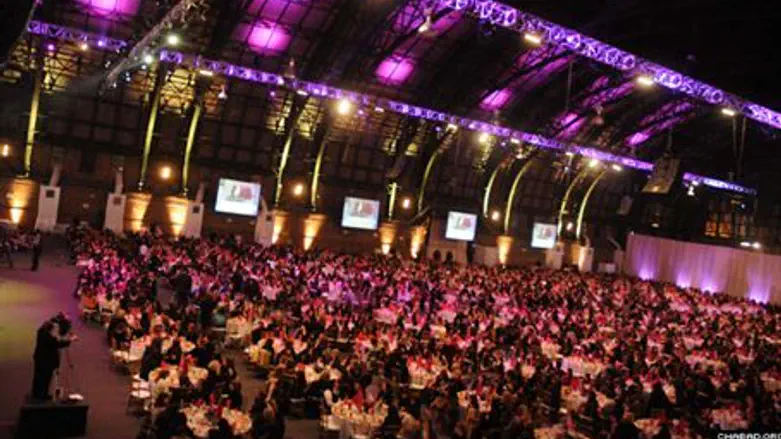
Anyone entertaining questions about whether the Chabad-Lubavitch movement treasures its women had those doubts removed Sunday night, where the security for the annual emissary banquet was as tight as it has been for presidential visits.
Dozens of New York City's finest joined a like number of operatives from a private Israeli firm to provide security as thousands of Chassidic women descended on the Brooklyn Armory for the annual banquet of the International Conference of Female Emissaries.

Three thousand emissaries and their guests from 76 different countries filled the block-long facility to standing room-only capacity. A dozen mammoth video screens projected the proceedings for those seated at hundreds of tables across the hall. More than a dozen computer screens were monitored under the watchful eyes of some 35 audio-visual technicians quietly tucked away from public eyes in the balcony of the facility.
In fact, all of the men were upstairs in a spot usually reserved for women, out of sight and mostly out of mind as the emissaries discussed what was foremost in their thoughts: how to juggle their twin responsibilities of serving their communities while taking care of their families.

All of the speeches paid tribute to Rebetzin Chaya Mushka Schneerson, the late wife of the Lubavitcher Rebbe, Rabbi Menachem M. Schneerson, o.b.m., noting how the rebetzin managed to perfectly balance the two jobs throughout her lifetime. The event is scheduled each year to commemorate the yarzheit of the rebetzin, who was renowned for her legendary ability to remember even "unimportant" details about those with whom she came in contact.

Dinie Greenberg, emissary to Shangai, served as emcee, introducing myriad speakers throughout the night. Of all those who spoke, however, the only men to address the gathering were the two most powerful in the movement.
Rabbi Yehuda Krinsky, secretary to the Rebbe for some 40 years, chairman of Merkos L'Inyonei Chinuch and head of Machne Israel, the movement's educational and social services division, who is also secretary of the Agudas Chasidei Chabad umbrella organization, and director of the Kehot Publication Society, spoke quietly and recounted his experiences with the Rebbe.
Rabbi Moshe Kotlarsky, vice chairman of Merkos L'Inyonei Chinuch, the educational arm of the movement, and head of the division that manages the emissaries, delivered a fiery speech on the merits of service to others, despite its difficulty. He told the crowd that by sending young couples out into the far-flung corners of the world on such an important mission, requiring mothers and wives to multi-task in so many ways, "the Rebbe created a league of Superwomen!"

But it was the roll call of emissaries at the end of the evening that made it clear just how far the movement has come in its drive to ensure that Jews throughout the world will always have someone to whom they can turn for spiritual aid when the chips are down.
From Nepal to Laos, Vietnam, and Korea, Thailand, India, Japan, China, Kyrgyzstan, Australia, Tunisia, Morocco, and the Congo, Venezuela, Brazil, Serbia, Croatia, Russia, Estonia, and dozens of others from Scandinavia, Europe, North and South America, each was called to stand up and accept applause.

Glittering attire, carefully coiffed wigs and high heels all combined to make it an evening to remember -- as did a performance by more than a hundred young girls who attend the movement's online school program for the children of emissaries in far-flung locations. Those students as well as their friends from across the United States also gathered in Crown Heights for the five-day convention for special programming sessions and a final night "on the town."
But it was at the end of the day that emissary Goldie Plotkin of Ontario, Canada emphasized the creed of the movement, and the women responded with a roar: "Rebbe, you can count on us!"
(All Israel news photos: Jonathan Alpeyrie/Chabad.org)