
Do American Jews belong in Israel – or are they better off remaining in the United States? How should Jews who live in the U.S. view Israel – as a homeland, or a “spiritual center” from which they can draw inspiration for their lives in the diaspora? Just where does their allegiance belong?
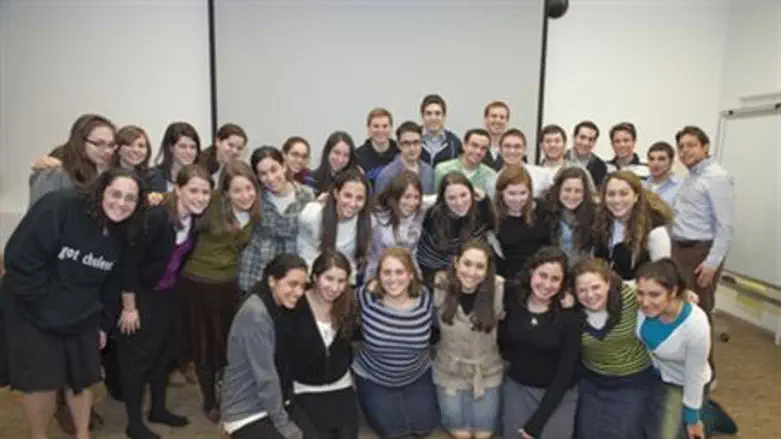
Weighty questions, these – and they are the questions being explored by 40 top students of Yeshiva University here in Israel this week, for a seven-day service learning and experiential education program entitled “A Place Called Home.” The program, organized by YU's Center for the Jewish Future, is an ambitious attempt to help young observant American Jews – the next generation of leadership in the American modern Orthodox community – just where Israel fits into their lives.
“Israel, for many young American Jews, is a broad and confusing topic, and many just don't know where to begin to relate to it,” says Shuki Taylor, the Center for the Jewish Future's Project Coordinator in Israel. “The goal of the mission is to show the complexities of running a Jewish homeland, taking into consideration the issues that must be dealt with when managing a society. By analyzing and trying to understand the issues and the different approaches to dealing with them, we hope to help students to clarify what their relationship with Israel should be,” Taylor says.
Each year, the mission has a unique theme (this is the fifth year the program is being run), and this year's program seeks to help participants deal with the reality of living with “the other,” those unlike themselves. For example, Taylor says, the group on Wednesday visited Mazkeret Batya, a unique community where observant and secular residents educate their children in the same school and use the same community institutions – unlike the usual pattern, where one group (usually the observant members of the community) open their own institutions in order to insulate themselves from lifestyles and ideas that run counter to their own.
“In a situation like that, you have to make a lot of compromises, but if we talk about unity and 'we are one,' Mazkeret Batya is a great example of how that works in the real world,” besides being a good example of the kind of compromises both observant and secular Jews have to make in order to live in the same society. Later, the group visited with members of Ayelet Hashachar, which sends observant families to live in secular neighborhoods – with the express intent of education the residents on Jewish issues. “That's another kind of coexistence, but a less compromising one. How does that model of unity compare to the model of Mazkeret Batya?” That, says Taylor, is the kind of question participants are tackling this week.
The group here this week is one of several that will be making similar journeys to Israel during YU's winter intersession break; the school also runs programs in the U.S., as well as abroad – this year in Ukraine, where participants learn about the challenges the Jewish community faces there. Missions are also sent to Mexico and Nicaragua, where participants do humanitarian work with local residents. Participants in all the programs are specially chosen, and are expected to take a leading role in their communities. “Many of the participants in the CJF's winter programs have gone on to careers in education and communal leadership,” says Taylor; and their experiences in the winter missions help prepare them for that leadership role.
In the case of the Israel mission, however, there's an additional factor – the tension between the sincere desire by many participants to make aliyah, and their reluctance to abandon life in the United States. “This is the essence of the dual-loyalty issues many of the participants face – do I remain in the U.S., strengthening the community, or make aliyah. And if I do go to Israel, how can I contribute to society, while maintaining my own identity and staying close to my loved ones? Is Israel the exclusive future, or is a full, Jewish life in the U.S. possible? These are the questions we are helping students to try and understand, if not answer,” says Taylor.
And each participant has to answer that question for him or herself. “When we designed the curriculum for these tours, we decided that it was not for us to lead a student to decide where to spend their lives. We lay the issues out on the table to help them understand the issues, but the decision is ultimately theirs,” says Taylor. “For many Orthodox students, the trip is a cathartic experience. For years they have been told that Israel is their future, and they carry that feeling like a burden –it's really heartbreaking, because many are torn between what they are supposed to do, and in many cases really want to do, versus the reality and the difficult questions involved in making aliyah. Making aliyah is much more than just immigrating to a new country – for many people, if they fail, they feel as if they failed in their ideology, in the essence of their being,” says Taylor. “Those are the kind of tensions we try to encourage students to understand and deal with, and hopefully they will go on to make the choice that is right for them.”