
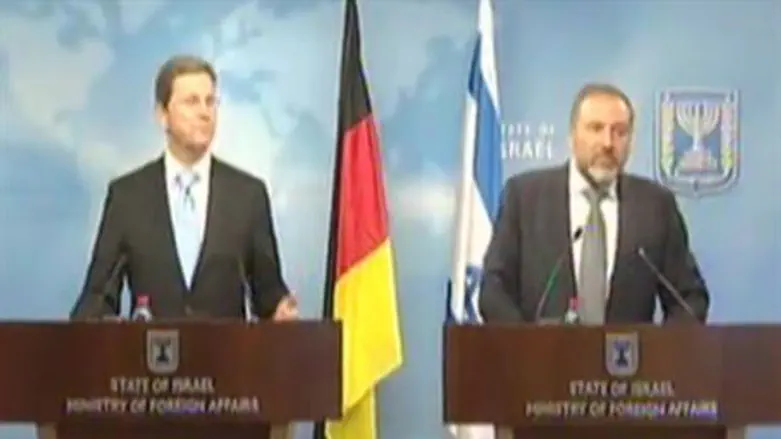
Visiting Germany Foreign Minister Guido Westerwelle told a press conference that Iran’s words “are not enough” but added he still seeks a diplomatic solution over the Islamic Republic’s unsupervised nuclear program.
He will visit Gaza during his tour but will boycott Hamas. He also will visit the family of kidnapped soldier Gilad Shalit.
At the press conference welcoming his German counterpart, Foreign Minister Avigdor Lieberman said that Iran is the biggest threat in the Middle East. “Not only Iran with its nuclear problem, but Iran through its proxies in its terrorist activity in all our regions,” is a danger, he added. “We see Iranian activities through proxies in Lebanon through Hizbullah, in the Palestinian Authority through Hamas, their deep involvement in Iraq, in Yemen, in Somalia and, of course, this threat may be the biggest threat that we are facing as a Western society, as a free society in the modern world.”
Foreign Minister Lieberman, in his usually frank manner, said that Germany and Israel “don't have an understanding on the settlement issue, but really, it's clear for me that the settlements are not obstacles to peace…. You must understand that we started with the settlement activity only after '67, and I don't remember that during 19 years, between '48 and '67, when the Arab world controlled all this territory, anybody tried to create a Palestinian state.”
Nevertheless, Westerwelle replied, “We think it would be a wise decision to freeze these settlement activities.”
Westerwelle called on Israel to lift its partial blockade on exports, arguing that it "strengthens the radicals and weakens the moderates and the opposite is what we should be doing." Foreign Minister Lieberman answered, “We are ready to export all their [Gaza’s] products to Germany, to the United States, to Japan. I'm not sure that there is a place in the market. The problem of the Gaza exports, first of all, is the problem of the market.”
Regarding Shalit, who has been in captivity for more than four years and whose condition is not known, the visiting Foreign Minister told reporters, “We think that our Israeli friends know that they can count on us. And I do not want to comment any further because it is very important that we help the family, that we help this poor young man and that we see him as soon as possible, safe and healthy, back in the arms of his family.
“So please understand that I do not want to comment on anything, not in this and not in the other direction. It is just a statement of solidarity of what I want to do here, what I want to address.”
Westerwelle said relations with Israel are excellent, not only because of “a very special responsibility for Israel” but also because “we both follow democratic values, and this is what counts for the future.”