
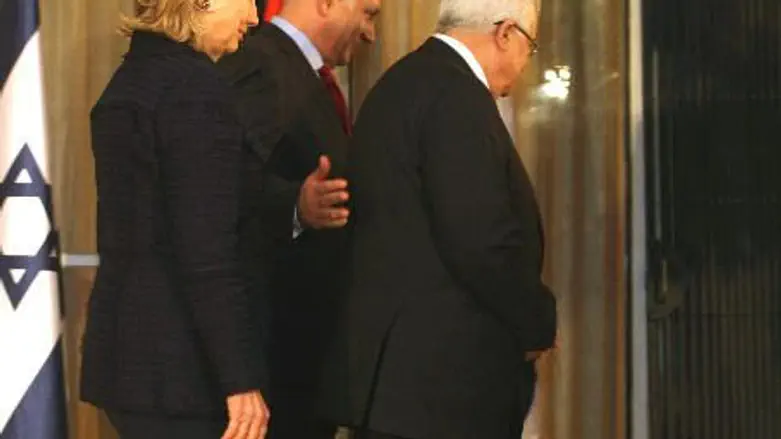
The U.S. is pressuring Israel to extend the freeze on Jewish construction in Judea and Samaria, but the prime minister is standing firm on his promise to resume construction in Jewish communities when the clock runs out on September 26.
According to a report published in the London-based Arabic-language newspaper al-Sharq al-Awsat, the U.S. is asking Israel to extend the freeze for three months in order to facilitate more direct talks.
During this period, it is reportedly hoped, the paper says, that Prime Minister Binyamin Netanyahu and Palestinian Authority Chairman Mahmoud Abbas will reach an agreement on borders for a new Arab country. Israel would then resume construction solely in areas to be left under its control.
The Arab newspaper reported that Abbas has accepted the offer, while Netanyahu has not yet responded.
Netanyahu spokesman Mark Regev told Israel National News, however, that the prime minister's position “has not changed.” He added that the Prime Minister's Office would not comment on any report in the international press.
Talks Moving Farther, Faster, Says Mitchell
Direct talks between Israel and the PA are moving farther and faster than expected, according to U.S. special Mideast envoy George Mitchell.
In what appeared to be an attempt to create more momentum, Mitchell told reporters in a briefing following the talks that Prime Minister Binyamin Netanyahu and PA Chairman Mahmoud Abbas were “productive” and focused.
The process, he said, has “gotten underway at a very rapid pace... The two leaders are not leaving the tough issues to the end of their discussions,” Mitchell said. “They are tackling up-front... the issues that are at the center of the Israeli-Palestinian conflict.”
The American envoy added that he and U.S. Secretary of State Hillary Clinton viewed the dynamic “as a strong indicator' that both Netanyahu and Abbas believe peace is possible, and “desire to conclude an agreement.”
He noted, however, that discussing issues “seriously” did not necessarily mean reaching an agreement on a resolution to them.
“It's not,” he said flatly. “It's a necessary predicate for it, and I don't want to suggest that just by talking seriously about serious issues that they've reached a concluding point.”
Nevertheless, Mitchell insisted the talks were moving along at a brisk pace.
“It has been extremely impressive to see both leaders engaging in this fashion. They are serious. They mean business. They do have differences. We believe they can be overcome, and we are going to remain and support them with patience, perseverance, and determination.”
Divide and Conquer with Shuttle Diplomacy
The two American officials split up Thursday morning on separate shuttle diplomacy missions around the region.
Clinton was scheduled to travel to Jordan to meet with King Abdullah II following a meeting with Abbas in Ramallah.
Meanwhile, Mitchell headed to Damascus for talks with President Bashar Assad and Foreign Minister Walid Mualem. Thursday evening, the American envoy is expected in Beirut for meetings that are scheduled to last through Friday.
Mitchell is set to meet with President Michel Sleiman, Prime Minister Sa'ad Hariri, and Speaker Nabil Berri, as well as with United Nations officials in the Lebanese capital.
Mitchell told reporters he will “seek to elicit their support for our shared goal of a comprehensive regional peace, and will do the same in the next few days with many other leaders from this region.”
One Step Forward, Two Steps Back?
Although both leaders previously agreed not to involve third parties in the negotiations between them, apparently that decision has changed.
According to Mitchell, the two sides will meet next week to continue discussions on the "core" issues – but it will be teams of negotiators who carry on the talks, rather than the two leaders.
Although the prime minister and Abbas will both be in New York next week for the opening of the United Nations General Assembly, as will U.S. President Barack Obama, no talks are scheduled between the two leaders at that time. Instead, he said, “that will be a subject of the negotiators for the two sides” who are set to meet next week. “Among the subjects that they will discuss will be the date and time of [the next] meeting,” Mitchell said.