
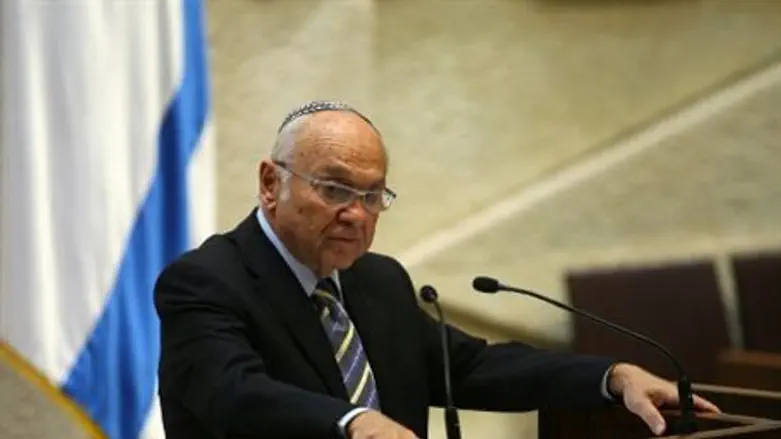
Over a year ago, MK David Azulai (Shas) pushed for a law initiated by the Honenu Legal Forum that would require the Israeli government to free Jews who are behind bars for security offenses every time Arab terrorists are freed as a result of agreements or prisoner exchanges.
The bill reached the Ministerial Committee for Legislation and was voted down without attracting public attention. As a result, it was removed from the Knesset agenda, despite prior reports that Committee Chairman and Justice Minister Yaakov Ne'eman supported it.
Arutz Sheva discussed the issue with MK Azulai.
"We are all praying for the release of Gilad Shalit, but we know that the price will very costly. Prisoners with blood on their hands will be freed, and that is why I thought that Jewish citizens who were arrested for security offenses should be freed as well. I called the suggestion 'egalitarian social legislation with regard to security prisoners'. However, it did not pass," said the MK.
Azulai added that in the past he was requested by security officials to rescind his suggestion so as not to affect ongoing negotiations. He cooperated twice until he felt that it was not possible for Knesset members to refrain from stating their positions on the matter.
The MK said that he presented the bill at this time because he had good reason to believe that Minister Ne'eman would support it. It is rare, if not unknown, that a commmittee chairman supports a bill and cannot get it approved. However, he added, it is not at all certain the the Minister actually had favored it in the committee vote. MK Azulai intends to present his suggestion to the Knesset, despite its failure in the ministerial committee.
At Honenu, efforts are being made to analyze what occurred. The organization disclosed that it is in possession of a document sent by Deputy Attorney General Malkiel Blass to Minister Ne'eman in which he pans supporting the bill for the following reasons:
"The bill restricts the governments authority in foreign relations and security issues and limits its discretion in how to react, for example, to freeing prisoners, victims of kidnapping and citizens who are in enemy hands. The government would have to take into account the price of freeing Israeli citizens who committed ideological crimes in addition to the price of freed terrorists.
"This would also encourage Israelis to commit such crimes, as they would know that their early release would be part of deals exchanging terrorists for Israelis held by the enemy.
"Freeing security prisoners is, in extreme situations, a necessity, but there is not justification to add to the list other released prisoners who committed serious crimes and can present a danger to the public."
Honenu reacted to Blass' recommendation, saying that they did not need to see Blass' report to know that the Justice Ministry does not feel any obligation to Jewish prisoners. "Blass and his friends," they retorted, "don't feel sick to their stomachs when terrorist murderers are freed, but they feel ill at the thought of freeing a few IDF soldiers and Jewish citizens who found themselves in jail due to the lack of protection provided by the government. These Israelis are not responsible for stepping in to do the IDF's job; the government that restrains the IDF is [doing so], but they are paying a heavy and personal price."
(translated from Hebrew site by Rachel Sylvetsky)