
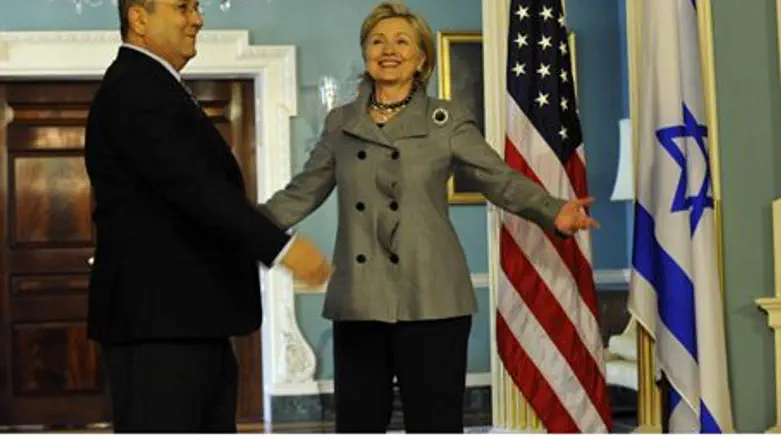
Indirect “proximity talks” between Israel and the Palestinian Authority will not lead to any breakthroughs, Defense Minister Ehud Barak told United States Secretary of State Hillary Clinton during a meeting Wednesday. Only direct negotiations will allow for a permanent, two-state solution, he said.
The two discussed ways to move quickly from proximity talks to direct talks.
Barak and Clinton also discussed other Middle East issues. Israel is concerned over Lebanon's difficulty in standing up to Hizbullah, Barak said.
Lebanon will bear responsibility for any attacks launched on Israel from its territory, he warned.
Regarding Gaza, Barak told Clinton that Israel is working to increase the amount of supplies allowed into the region via Israeli crossings, but will continue to control the flow of goods in order to ensure that terrorists do not obtain weapons or weapon-making materials.
He expressed appreciation for America's favorable response to the Turkel Commission, which is to investigate a violent clash between IDF soldiers and foreign activists who attempted to break Israel's naval blockade on Gaza. The United Nations has termed the commission insufficient, and is seeking to create an international inquiry.
Israel will continue to prevent ships from reaching Gaza, Barak said. Instead, he said, they will be rerouted to Ashdod, where any goods destined for Gaza will be inspected and then sent through via land crossings.
The defense minister also mentioned kidnapped Israeli soldier Gilad Shalit, who was abducted by Gaza terrorists four years ago. Shalit's captors have not allowed Red Cross representatives to visit the captive soldier, in violation of international law. They demand that Israel release over one thousand terrorists prisoners in exchange for his freedom.
The two discussed ways to move quickly from proximity talks to direct talks.
Barak and Clinton also discussed other Middle East issues. Israel is concerned over Lebanon's difficulty in standing up to Hizbullah, Barak said.
Lebanon will bear responsibility for any attacks launched on Israel from its territory, he warned.
Regarding Gaza, Barak told Clinton that Israel is working to increase the amount of supplies allowed into the region via Israeli crossings, but will continue to control the flow of goods in order to ensure that terrorists do not obtain weapons or weapon-making materials.
He expressed appreciation for America's favorable response to the Turkel Commission, which is to investigate a violent clash between IDF soldiers and foreign activists who attempted to break Israel's naval blockade on Gaza. The United Nations has termed the commission insufficient, and is seeking to create an international inquiry.
Israel will continue to prevent ships from reaching Gaza, Barak said. Instead, he said, they will be rerouted to Ashdod, where any goods destined for Gaza will be inspected and then sent through via land crossings.
The defense minister also mentioned kidnapped Israeli soldier Gilad Shalit, who was abducted by Gaza terrorists four years ago. Shalit's captors have not allowed Red Cross representatives to visit the captive soldier, in violation of international law. They demand that Israel release over one thousand terrorists prisoners in exchange for his freedom.