
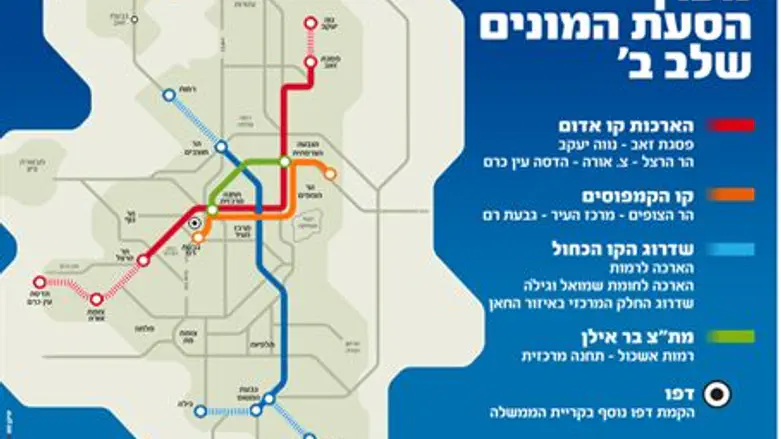
Jerusalem Mayor Nir Barkat and Transportation Minister Yisrael Katz have unveiled a new plan for public transportation in the capital that spans half a decade, costs 8 billion shekels, and includes additional light rail lines.
Israel National News spoke with Shmuel Elgrabli, strategic advisor for the Light Rail and Rapid Transit project, which operates under the auspices of the Ministry of Transportation and the Jerusalem Municipality.
Elgrabli said that the first stage of the project will be up and running by approximately April 2011, less than a year from now. That includes a light rail line running from Pisgat Ze'ev to Mt. Herzl, and the Rapid Bus Transit line from Talpiyot to Har Hotzvim. This first stage will enable 250,000 passenger trips per day. "The goal is to bring Jerusalem to a new level of public transportation," he said. "The CityPass company will operate the Light Rail, and the Egged Bus Company will operate the bus line."
But this is not enought, it was realized, and additional light rail and bus lines are at the heart of the new plan. "We realized that to solve the problem, one light rail line and one bus line are not sufficient,” Elgrabli explained. “The first additional line will connect the university campuses, running from Mt. Scopus in the east to Givat Ram and the museums on the western side of the city, via the center of the town. This line will extend 11 km in total, 8 km of which are part of the initial light rail line. This makes optimal use of the existing light rail infrastructure, but adds another 50,000 passengers per day."
The new plan also includes an extension of the initial light rail line as far as the N'vei Yaakov neighborhood in the north, and Hadassah Ein Kerem in the south. This extension will add tens of thousands of additional passengers. The plan also includes a new rapid bus line from Ammunition Hill and Ramat Eshkol to the Central Bus Station, intended to provide a solution for hareidi-religious residents.
Part of the challenge, says Elgrabli, is getting people to change their habits. "It's hard to make car drivers move over to public transportation. The way to do it is by making a major, modern change. This has been done in Europe, but also in Israel. The high speed railway line from Tel Aviv to Haifa, which now takes less than an hour, attracted many car drivers to switch over to the train. We hope to do something similar with the light rail and rapid buses in Jerusalem."
The light rail is not incredibly fast, but Elgrabli says it will be faster than cars traveling in the city. "The top speed is 60-70 km per hour, and the average speed is 28 km/h. That doesn't sound like a lot, but in reality it is, since a car traveling through a traffic-congested city has an average speed of 5 km/h because of traffic, pedestrians, and traffic lights. When the light rail goes through the center of town, it will slow down too, for safety reasons. It will be kind of like a moving sidewalk."
Elgrabli is proud of the size and frequency of the light rail as well. "500 passengers can fit into one car. During rush hour, there will be a train every three minutes. At each stop, there will be a machine for buying passes [tickets]. A card will be available to which people will be able to add credit. There is even a company now that is offering to enable payment via cellphone."
"People are going to be attracted to the light rail due to its punctuality and the ease of entry and exit. There will be eight doors on each train. There are, of course, security considerations that will slow things down a bit, but we are working with Israel Police and Israel's security authorities to ensure the safety of the passengers and at the same time keep the traffic moving smoothly."
When asked when the first trip will take place, Elgrabli said he couldn't promise that it would happen by the target date of April 2011, "but it should happen within no more than 2-3 months from that date."
"There will also be shuttle buses that will take passengers from Jerusalem's surrounding areas to the light rail, for example, from the Binyamin Region northeast of the capital," Elgrabli noted.
Elgrabli says that the work included in the new plan will be completed by 2015 or 2016, adding that while these years will be difficult for Jerusalem residents, "a few years of discomfort are worth it. What are three or four years, compared to 3,000 years? It's nothing."
When asked about the anger of Jerusalem residents over the two-year delay on delivering the light rail, Elgrabli says the anger was justified in part: "They should understand that the infrastructure and the state of the city center was no less than archaic, with even remnants of Turkish times, and to revive it, the transportation had to be improved. This revival is historic. I hope that after this period of labor pains, the citizens of Jerusalem will enjoy the fruits of the labor. We also learned many lessons along the way, and we believe that the future lines will be built much more efficiently. The additional lines will not be added to the city center, and therefore we are letting the center rest for five years. We ask the populace to be patient. It is said that anyone who builds a building in Jerusalem brings closer the building of the Holy Temple. I truly believe that what we are doing is for the good of Jerusalem."