
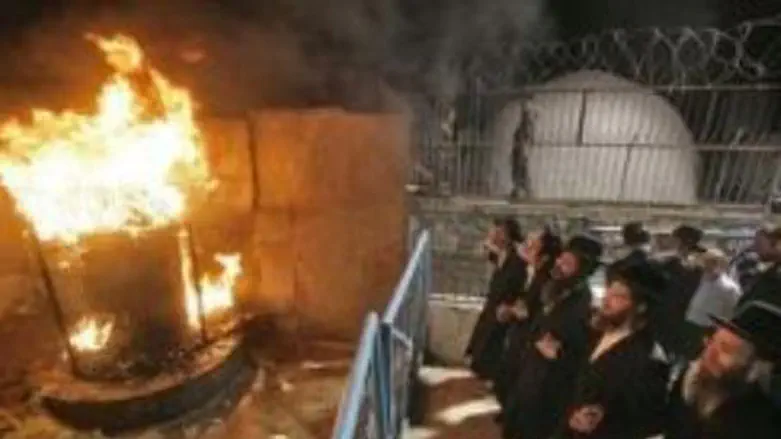
With hundreds of thousands traveling northward in the coming days to the gravesite of the holy Sage Rabbi Shimon bar Yochai in the Galilee, emphasis has also been placed on road safety.
The National Road Safety Authority (NRSA) has come out with a two-pronged campaign, asking visitors to either go by bus, or to make sure to drive safely. Specific emphasis has been placed on using seatbelts even in the back seats – long the law in Israel – and making sure that drivers have had enough sleep before setting out. Drivers are asked to double-up with each other so as to be able to replace each other when the need arises.
Lag BaOmer is the traditional anniversary of the death of the “Divine Tannaitic Sage” Rabbi Shimon bar Yochai, considered to be the author of the main work of the Kabbalah, the Zohar. 
The NRSA campaign, recalling last year's tragic accident in which two adults and three children were killed on their way back from Lag BaOmer celebrations in Meron, states, "Let's make sure that the only memorial candles we have to light this year are for Rabbi Shimon bar Yochai."
Magen David Adom, Israel's national medical emergency service, will be on maximum alert in Meiron in the days preceding Lag BaOmer, which begins after the Sabbath and ends Sunday evening. Hundreds of medics and other volunteers, ten ambulances, five motorcycles, a mini-tractor and three clinics are already on site. Hundreds of people are generally treated during the course of the Lag BaOmer celebrations.
In order to prevent traffic congestion and other problems, private cars will not be permitted into the holy site this year.
What's All the Fuss About?
The minor holiday of Lag BaOmer is the traditional anniversary of the death of the “Divine Tannaitic Sage” Rabbi Shimon bar [son of] Yochai, who is buried in the Galilee town of Meron, just west of Tzfat (Safed) . Rabbi Shimon is considered to be the author of the main work of the Kabbalah, the Zohar.
The day's name comes from the fact that it is day number 33 (lag, in Hebrew numerology) of the Omer counting period between Passover and Pentecost (Shavuot).
The date also marks the end of a plague that struck down some 24,000 students of Rabbi Akiva, as well as the heroic but failed attempt by military leader Shimon Bar Kokhba, Rabbi Akiva's protege, to throw off the Roman yoke in 135 C.E.
Much about this day is "shrouded in mystery," as the late Rabbi Shlomo Goren, Chief Rabbi of Israel and of the IDF, once stated.
All-night bonfires, klezmer music, singing, dancing, prayers and the traditional first-time haircuts for three-year-old boys are part of the Lag BaOmer commemorations, and particularly in Meron. Hundreds of thousands of people generally visit Meron on or before Lag BaOmer to take part in the spiritually joyous celebrations, some flying in from abroad.