
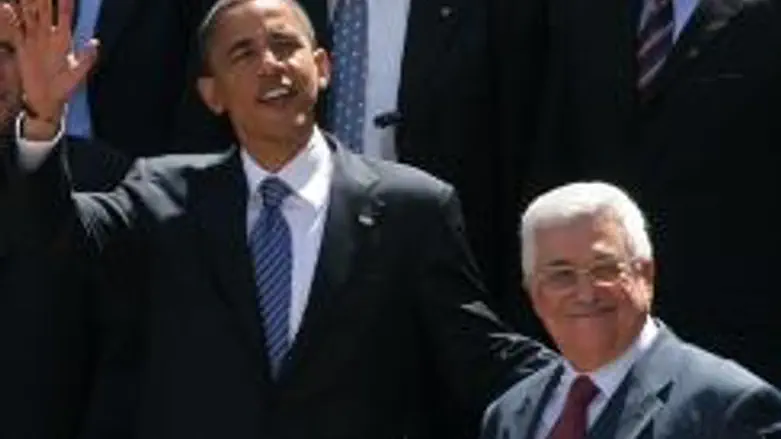
Palestinian Authority Chairman Mahmoud Abbas, emboldened by U.S. President Barack Obama’s tough talk on Israel, has rejected American-mediated talks with Israel unless Israel agrees to demands to stop building for Jews in most newer parts of Jerusalem.
Abbas told the Arab League summit in Libya that Israel must make more concessions in accordance with President Obama’s view that large parts of Jerusalem are “occupied.” Prime Minister Binyamin Netanyahu has agreed to open up the status of the capital, as well as all other issues, for negotiation. The move was a concession to President Obama to enable the PA to resume indirect talks, but Abbas has now demanded further concessions.
President Obama has insisted that he is not imposing an agreement on Israel, but Abbas has taken the president’s condemnation of Israel’s building for Jews in all of Jerusalem as a signal that Israel can be pushed into a diplomatic corner. Abbas turned the American position into a pre-condition for talks and a non-negotiable part of a final agreement for establishing the PA as a country.
The Executive Branch’s policy contradicts stated Congressional policy, expressed in law, that Jerusalem is the united capital of Israel.
 Abbas used the Arab League summit, with nearly half of its members absent from the meeting in Libya, to declare that Jerusalem is a “jewel” that cannot be compromised.
"We cannot resume indirect negotiations as long as Israel maintains its settlement policy and the status quo," he said. "Negotiations on…borders would be absurd if Israel decides [the borders of a new PA state] on the ground. We have always said that Jerusalem is the jewel in the crown and the gate to peace."
While Arab League Secretary-General Amr Moussa said that the Arab world should prepare for the possibility of "complete failure" of the American-led diplomatic process on behalf of the Palestinian Authority, United Nations Secretary General Ban Ki-Moon lent support for Abbas' demands. He again “condemned” Israel for building for Jews in areas of Jerusalem where the United States does not recognize Israeli sovereignty and where 300,000 Jews live.
The Arab League was less united on Iran, rejecting Amr Moussa’s suggestion to open dialogue with Iran, which is defined as Persian and is not part of the Arab League. Egyptian Foreign Minister Ahmed Abul Gheit told reporters, “Most of the Arab countries don't welcome this for now."