
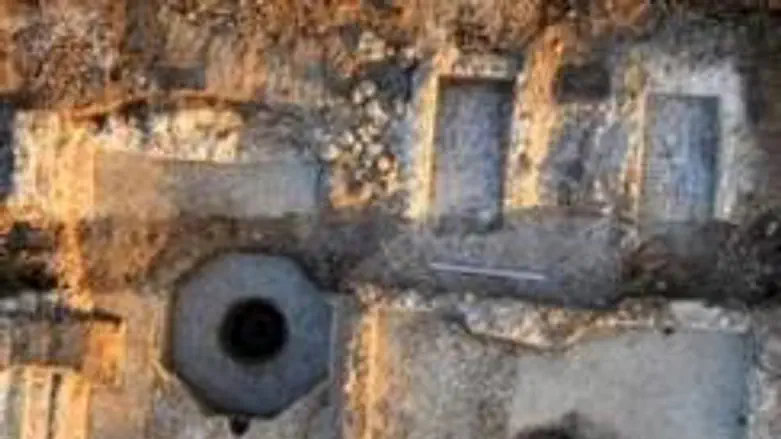
The Israel Antiquities Authority announces the discovery of a 1,400-year-old wine press in the vicinity of Nahal Sorek - one of the largest ever found in Israel. The location is approximately midway between Jerusalem and Ashdod.
The wine press was unearthed during a salvage excavation in a region to be used for agricultural farmland by Gush Katif expulsion victims from Ganei Tal. Their permanent homes are being built nearby, just outside Kibbutz Chafetz Chaim. The head of the Nahal Sorek Regional Council, Eli Eskozido, said he will ensure the conservation of the site and its opening to the general public.
The wine press, used to produce wine in the 6th-7th centuries C.E. (Late Byzantine period), measures 6.5 x 16.5 meters (17 x 41 ft.).
Excavation director Uzi Ad said, “The size of the wine press attests to the fact that the quantity of wine that was produced in it was exceptionally large, and was not meant for local consumption. Instead, it was intended for export, probably to Egypt, which was a major export market at the time, or to Europe. An identical wine press was previously discovered north of Ashkelon, about 20 kilometers from the wine press that was just found in Nahal Sorek, and we can assume that the two installations were built by the same craftsman.”
Ad notes that the collecting vats of the wine press "were neither circular nor square as was the custom, but octagonal. And since this method of construction is far from being practical - because sediment would accumulate in the corners of the vats - it seems that they were built in this manner primarily for aesthetic reasons.”
“This is a complex wine press that reflects a very high level of technology for this period," Ad concludes, "which was acquired and improved on from generation to generation."
The wine press originally included a central treading floor with a mosaic pavement on which the grapes would be trod. The must (unfermented grape juice) would flow from the treading floor to a distributing vat that was originally elliptical. From there, it was directed through a hole to one of the two collecting vats located on either side. The must would remain there for three to five days, during which time different ingredients were added to cause it to ferment and become wine.
A round sump that was used for collecting the waste grape sediment was also discovered in the middle of the mosaic pavement in the two collecting vats.