
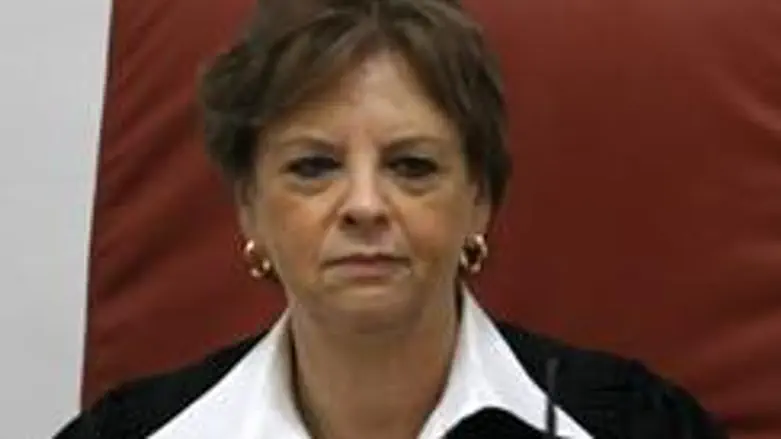
Supreme Court President Dorit Beinisch expressed hinted criticism of the decision to freeze construction by Jews in Judea and Samaria Wednesday, when hearing a petition against the freeze.
"I do not know how much thought was given by the issuer of the order to all the variants of the possible damages [the freeze would cause],” she said.
She asked the State's representative, Attorney Hani Ofek, if the State had established a mechanism for compensating those who would be hurt by the freeze.
Ofek said: “There is the cabinet decision which gave 30 days for finding the sources for funding. We will make an effort and this is being taken care of at senior levels. Obviously [compensation] is a part of the order. This is implied in the cabinet decision and it is perceived as part of the order. So I imagine that it will take time to complete it.”
Beinisch instructed Ofek to “pass on this request to wherever it needs to be passed on to.”
'300,000 are suffering'
The petitioners were 14 local government authorities in Judea and Samaria. They claimed, among other things, that the State did not have authority to make the decision to freeze construction. Judge Beinisch replied by asking: “If it had been a diplomatic question, a national question or one pertaining to security, then could the State not freeze? They are not evicting or expropriating; this is a statement by the State that it is talking about 10 months [of a freeze]. It is damaging, but the damage has boundaries. This thesis could change in the future.”
Avi Naim, the head of the Beit Aryeh Local Council, said that the petitioners accept the State's authority, but that “we have reached the place where we need to cry out in the name of the Israeli population. There are 300,000 people who are suffering damage of this kind or another. These people are receiving services from the local authorities. These are indirect damages and therefore they will not be included in the compensation mechanism.”
"We are talking about thousands of law-abiding citizens of the State of Israel who have been gravely hurt,” he added. “They put their savings in there. The lack of proportionality in the order as it was written is outrageous... And the damage is not just financial, it is also emotional.”