
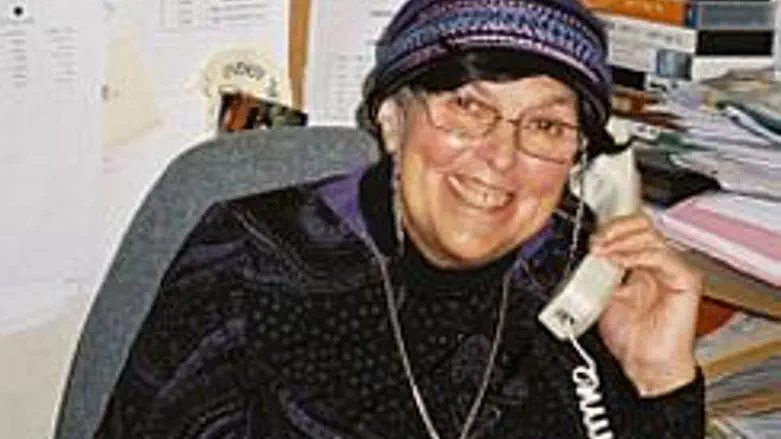
Memory loss often can be improved and is not necessarily a sign on Alzheimer or dementia, according to geriatric social worker Leah Abramowitz, a former American who was chosen to receive the city of Jerusalem’s highest honor for her work.
She tells the story of “Sima,” who was worried about memory lapses. “She found herself going into a room but couldn't remember why,” Abramowitz relates. “When she met people she knew well but couldn't recall their name, she found diplomatic ways to avoid revealing this embarrassing fact. Her children already knew the familiar refrain: ‘Has anyone seen my reading glasses?’”
Her worries brought her to seek medical advice after she found herself wandering around an underground parking lot for 30 minutes while looking for her car,
A battery of tests by doctors and psychiatrists ruled out Alzheimer’s disease or any cognitive impairment and concluded she problem suffers from “Mild Cognitive Impairment” (MCI), meaning a weakening of memory just as hearing and vision weaken in the aging process.
 Abramowitz said Sima’s doctor explained several characteristics of MCI:
--Self-reported memory complaints;
--Some detectable memory deficiency;
--Other cognitive functions, such as judgment, learning ability and reasoning, remaining normal;
--Daily living activities, such as driving ability and balancing the checkbook, remaining normal are normal;
-
-No signs of Dementia.
The doctor also said that only 3.5 percent of the elderly ever suffer from Alzheimer’s and dementia although the rate increases to 35 percent in the over-85 population.
Abramowitz, who teacher a memory improvement course, explains that normative memory loss, unlike dementia, is not progressive or debilitating and does not interfere with the normal activities of daily living.
The memory loss can be compensated, according to Dr. Tzvi Doweletzky, the director of the Memory Clinic in Be’er Sheva. "Compensation is something we do all the time. When we wear glasses, use a microphone or take a walking stick, we're compensating for some physical deficiency. Similarly, we need not be embarrassed to use certain accessories or tricks to make up for cognitive decline.”
“There are three major stages involved in remembering things, whether an appointment, the name of a neighbor or where we put the car keys,” according to Abramowitz, a native of St. Louis, Missouri. “They are: retention, storage and retrieval.
“Retention refers to how we absorb information. Do we concentrate on the name of people to whom we're introduced at a function? Are we overwhelmed by other stimulants, background noises, or additional distractions?
“Storage or encoding is how we categorize the information to which we're exposed. Is it marked in our mind as being of ‘top importance’ and reviewed again and again? Do we use mind games or tricks to remember lists of names, numbers or facts? There are many methods to improve our memory by alphabetizing, using associations and creating stories out of material we wish to retain.
“Finally, recall or retrieval is the ability to pull out the retained information at will. Sometimes we use cues to retrieve information that we need. We recall the setting where we were when we last used our diary, or we pronounce the first name of an acquaintance and that automatically brings on the last name--hopefully. Some therapists recommend saying out loud, 'I've shut off the gas’ before leaving the house, or ‘I'm hanging up the keys on the chain near the door’ to use verbalization and hearing as an extra booster.”
She also advises that anxiety often blocks the recall process and points out that older people often have to make more of an effort and exercise more patience to recall things.
Can medicine improve the memory? “There are no dramatic breakthroughs yet in finding the ultimate memory enhancement pill despite millions of dollars that are invested annually in this pursuit,” Abramowitz says. “Perhaps in the future there will be a magic potion, but not yet.”
She concludes, “The main thing is retaining a positive attitude.”
For those interested in participating in an English speaking course on “Improving Your Memory” which begins in the near future in Shaare Tzedek Hospital, contact Leah Abramowitz at 02-6555198.