
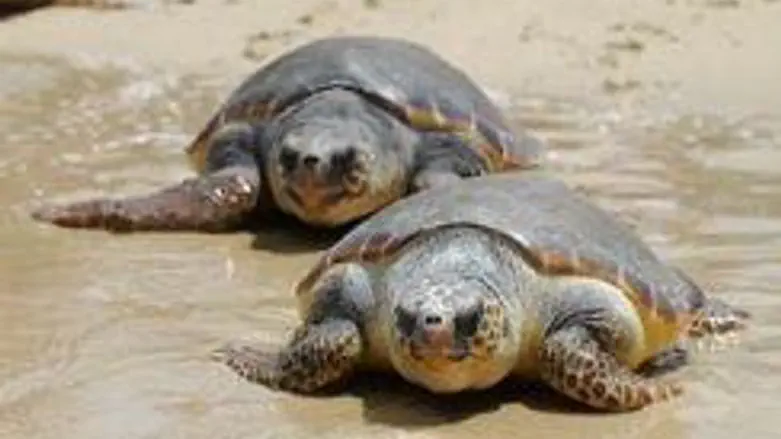
The sea turtle was still alive, but just barely. He lay on his back on the sidewalk, weakly waving his stubby webbed feet in the air. Nonetheless, his fate was sealed.
The fisherman who had caught him in his net a few miles from the shoreline of Gaza said he planned to take the turtle home and eat it. "Abu Mohammed", as he agreed to be called, admitted to TIME magazine that he knew it was illegal to catch the sea tortoise, which under international law is an endangered species -- but it didn't matter.
Environmental protection measures are not enforced within Gaza nor along its shoreline by the Hamas terrorist organization that controls the region, he said. The fisherman argued that "life in Gaza is too full of despair to play by the rules."
Local Gaza fishermen complain they are restricted to sailing within a few miles of the coastline, thus creating a dense traffic area. "Big fish are located about 15 kilometers away from shore, but [Palestinian Authority] fishermen are not allowed to go out that far, so they make do with what they have," explained Muhammad al Hisi, who serves as a consultant for the fishing industry in Gaza.
The little sea turtle, he said, is just a small indicator of what is happening on a much larger scale. Al Hisi said that Gaza fishermen are using nets smuggled in from Egypt with much smaller holes, that allow them to catch much smaller fish. He noted that maritime regulations would not allow this, because it prevents fish from reproducing and replenishing their population. He added that if the situation continues, it will cause significant harm to the environment. Because there is no agreement between Israel and the Palestinian Authority, Al Hisi said, the risk of other environmental damage is also increasing. The Gaza beach area has already begun to erode, and "the fish industry and the environment have become hostages in the conflict."
Gaza fishermen told Time magazine the Israeli naval vessels that patrol the Mediterranean waters along the coast shoot at fishermen if they venture out past the five-kilometer mark. Human rights activists also claim that Gaza fishermen are in danger of arrest by Israeli patrol boats.
However, Israel's Defense Ministry has explained that the Gaza coast is used as a means of infiltrating Israeli territory in order to smuggle in arms, ammunition and other contraband, or to carry out terror attacks against Israeli citizens.
Terrorists have been caught posing as fishermen and collecting the ordnance which they then use to attack Israeli civilians in the western Negev. The weaponry and ammunition is dropped off in water-tight containers by boats that ply the sea lanes.
Since 2007, when Hamas seized control of the Gaza region, the area has been partially sealed off by Israel, which has allowed thousands of massive trucks laden with foodstuffs and other supplies to enter the area. In addition, medical patients, diplomatic personnel and non-governmental workers travel in and out of the region through the Erez Crossing, and at the southern end of Gaza. Egypt also regularly opens the Rafiah crossing to enable Gaza residents to do their shopping in nearby towns that hug the border.
The closure was initiated following the Hamas military takover of Gaza and its unwillingness to return kidnapped IDF soldier Gilad Shalit, abducted by the terror group's operatives in a cross-border raid on June 25, 2006. Hamas still is violating international laws by not allowing anyone, including representatives of the International Committee of the Red Cross (ICRC), to have access to Shalit to ascertain his condition.
Until the IDF finally launched the counterterrorist Operation Cast Lead on December 27, 2008 -- the operation lasted until the day of the U.S. inauguration of President Barack Obama -- Hamas had continued to fire thousands of rockets and mortars at Israeli civilians, killing and maiming men, women and children in the south of the country. One study last year estimated that some 90 percent of the population of the Gaza Belt city of Sderot suffers from Post-Traumatic Stress Disorder as a result of the unrelenting attacks.