
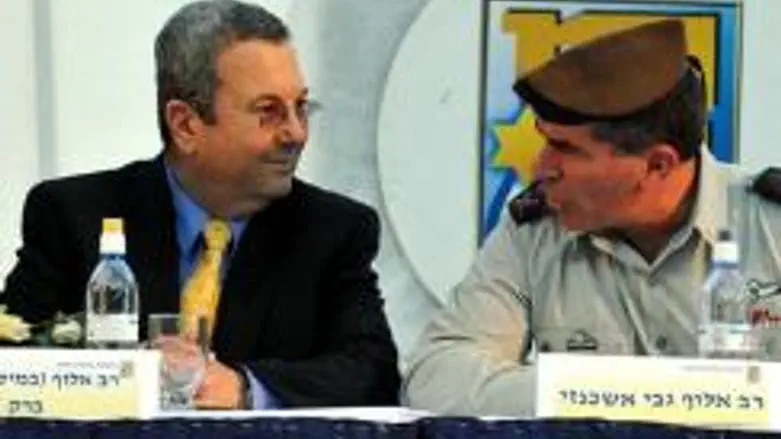
Coalition partner and Defense Minister Ehud Barak, who vowed after the national elections last February that his Labor party would sit in the Opposition, now has changed his positions on Iran and hilltop communities, also known as outposts.
Last February, Barak, chairman of the Labor party, told IDF officers, “A nuclear Iran is without a doubt the main threat to world order and may lead to mass nuclear proliferation in the entire Middle East” and “Iran may become an existential threat to Israel.”
He later told the Washington Post, "Our interpretation is that clearly the Iranians are aiming at nuclear capability. [The Iranians "are probably already working on warheads for ground-to-ground missiles. The dots that we see...cannot be easily connected in a way that does not lead to a nuclear program.... The leading intelligence communities should concentrate on finding whether there is...a clandestine enrichment operation and a weapons group working on the weapons technology.”
However, last week, Barak changed his tune and tone. He told an Israeli newspaper that “Iran is not an existential threat” because Israel can defend itself if Iran develops a nuclear weapon. He then explained to The New York Times that he did not mean that Israel is not concerned but simply wanted to put Israelis at ease and not panic.
Barak then offered advice to the United States, saying that “a coherent move toward blocking nuclear proliferation should start with North Korea. It would have very positive ramifications for blocking Iran.”
The Labor party chairman and Defense Minister, who angered a large number of his Knesset Members by deciding to sit with the Netanyahu government after vowing to join the Opposition, also has reversed his stand on destroying Jewish hilltop communities in Judea and Samaria.
He has repeatedly said that he will carry out the destructions and expulsions in two dozen communities, as U.S. President Barack Obama has demanded. As recently as last month, his office stated, "The Defense Minister has declared a number of times that the evacuation of illegal outposts is our obligation as a democratic state. This is a process which will be implemented in weeks, not years."
However, he told an Israeli newspaper last week, “The outposts won't be evacuated overnight. When I said it was a matter of weeks or months I meant the time it would take after the peace process is renewed. When we start on the path, each side will deposit with the American president a series of steps that he plans to carry out. There is no reason to evacuate outposts before the process is restarted."
Concerning the suspended negotiations with the Palestinian Authority on a new Arab state within Israel’s borders, he told The New York Times, “I fear the Palestinians are going to miss a huge opportunity. There is a president who says determinedly, ‘I am going to put my political capital into making sure there is an independent Palestinian state and solve all the core issues in two years.’ If we bear in mind Israel’s security needs and the demand that a final agreement means an end to the conflict, this is an opportunity that must not be missed.”
Barak was Prime Minister in 2000 when then-PA leader Yasser Arafat rejected his offer to turn over almost all of Judea and Samaria, including part of eastern Jerusalem, to the PA. Arafat followed his refusal with the launching of the nine-year-old Second Intifada, also known as the Oslo War.