
Likud party negotiators began meeting with nationalist and religious parties in an effort to close an agreement for a new government after Kadima leader Tzipi Livni rejected an invitation to join a national unity government.
However, Livni agreed to meet with Prime Minister-designate Binyamin Netanyahu again for further talks despite her rejection of Likud principles. She said her refusal was based on her insistence that the Likud change its platform concerning the status of the Golan Heights and the process towards creating a new Palestinian Authority state.
Netanyahu, buoyed by support from outgoing Prime Minister Ehud Olmert and President Shimon Peres, began to work on Livni’s conscience this week, stating that the future of the country is at stake and overrides political aims.
Israeli media, which play a large role in shaping the news, have also begun turning up the volume for a unity government as it becomes clear that Livni’s claims of having won the election have no relevance.
Her Kadima party edged out Likud 28-27, but no other party has backed her to lead a coalition. Netanyahu has the backing of 65 Knesset Members, four more than an absolute majority, and his negotiating team is meeting with representatives of Israel Is Our Home (Yisrael Beiteinu), Shas and United Torah Judaism (UTJ) Wednesday.
The other potential coalition partners are Ichud Leumi (National Union) and Jewish Home, two nationalist parties.
Electronic media, particularly the influential Voice of Israel government radio and Channel 1 television's Mabat news program, backed Livni after she “won” the election. The media backtracked from a campaign touting her to head the government as it became clear that no other party wants her.
Their interviews with political leaders over the past several days have focused on Livni’s “intellectually honesty” in refusing to compromise party principles while suggesting that Netanyahu can find common ground with her.
The ostensible differences on the creation of a Palestinian Authority as an independent state are more virtual than real and leave room for discussion. Netanyahu has not rejected a “two-state solution,” despite media claims to the contrary, and campaigned on a platform of "economic peace” by which the PA would be a financially stable entity before heading a new country.
Likud MK Benny Begin said this week that a compromise is not important because he thinks that any PA-Israel agreement will be based on so many question marks that it will not be implemented.
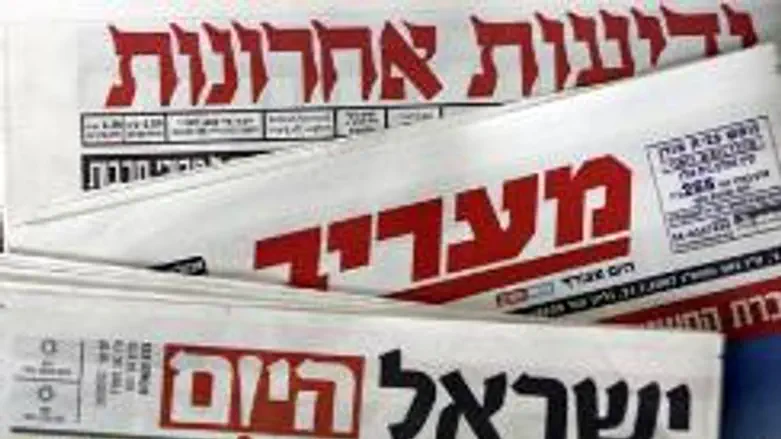
Print Media Also Back Unity
The print media have also increasingly backed a unity government, fearing a majority of nationalist and religious MKs in the Knesset after three years under the increasingly secular leftist influence of Prime Minister Olmert and his wife Aliza, a former Peace Now spokeswoman.
A Yisrael HaYom op-ed article Wednesday stated, “It is important to remember that a unity government would also provide the joint basis to lessen the effect of the global economic crisis, without falling victim to the traditional extortion of the smaller parties."
On Tuesday, the newspaper, Israel’s third most popular, maintained that a substantial number of Likud and Kadima MKs want a unity government. Last week, the same newspaper published an article stating that Livni “has no moral option to slam the door on a Netanyahu government even before it is opened.”
Articles in the Hebrew-language daily newspaper Yediot Acharonot generally have supported Livni’s uncompromising stand while implicitly waiting for Netanyahu to compromise.
Hebrew-language daily Ma’ariv has been more forceful, with one article bluntly stating that Livni “should come down from her tree.”
The Jerusalem Post editorialized after the election results were announced, “It is clear that the two winners need to join forces in a national unity government."
Both Netanyahu and Livni have a lot to lose and gain no matter what they decide. A narrow coalition will be an expensive proposition because of monetary demands by the factions. However, if the nationalist and religious parties can maintain political peace with each other, Livni faces the prospect of being blamed for not taking the opportunity to work within the coalition as the nationalist and religious parties shape Israel’s policies without Kadima.
If she agrees to sit with the Likud, the left-wing flank of the party may accuse of her throwing away the chance that a narrow coalition will fall, leaving her with the opportunity to form a government or going to the polls again.