
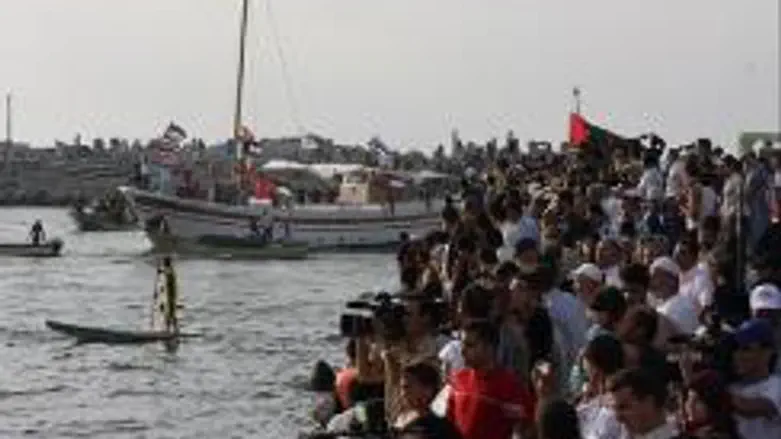
The 15-member United Nations Security Council rejected a Libyan appeal on Wednesday that its ship had the right to force its way into Israel's waters without permission.
Libya, which sent a cargo ship to Gaza on Sunday, was within its rights to demand the emergency session because it is one of 10 rotating members of the Council. Although a number of nations criticized Israel for its blockade of Gaza and voiced concern over the humanitarian situation in the region, the Council did not support the Libyan claim against the Jewish State.
Ambassador Giadalla Ettalhi protested that Israel had blocked its ship from reaching Gaza, claiming the vessel was filled with humanitarian aid. The move, calculated to break Israel's sovereignty over the region's coastal waters, followed several similar voyages by the pro-Arab "Free Gaza" organization.
The Israeli Navy blocked the Libyan Al-Marwa from proceeding to the Gaza shore with 3,000 tons of food and medicines. The outraged Arab representative told the Security Council that Israel was guilty of "piracy on the high seas" and demanded "effective action that will ensure compliance of Israel with international humanitarian law and the law of the seas."
The Council invited Israeli Ambassador Gabriela Shalev to respond to Libya's remarks, although the Jewish State is not a member of the council. Shalev sharply rejected the charges and leveled one of her own, accusing Libya of provocation and reminding the Council that Libya does not recognize the State of Israel.
"No member State of this Council, nor any other member of the United Nations, would allow a shipment originating from a hostile state towards a territory that serves as a launching pad for terrorist attacks against its civilians," she declared.
United State Deputy Permanent Representative Alejandro Wolff backed Israel, calling it "absurd to assert Israel committed an act of piracy" since the Libyan vessel was never boarded, nor was any shot fired at the ship. He called the attempt to enter a closed sea port, rather than donate the humanitarian aid through the normal channel "dangerous and irresponsible."