
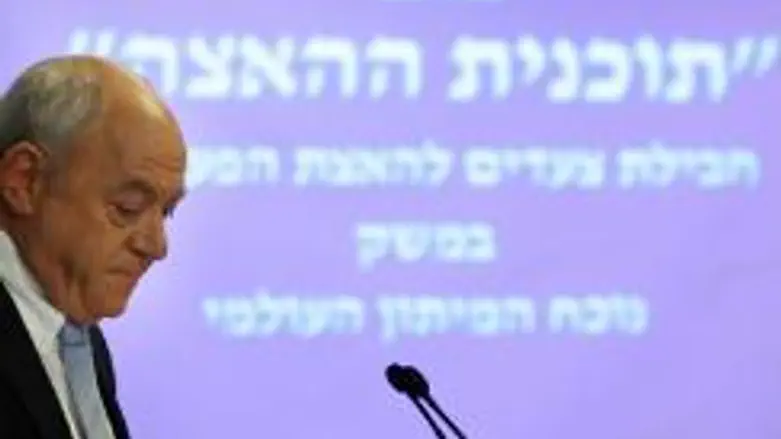
Finance Minister Ronnie Bar-On (Kadima) unveiled on Wednesday a $5 billion stimulus plan for the economy that is aimed at adding 10,000 jobs. Opposition parties and even several coalition members opposed it. Investors were unimpressed and continued to sell stocks, driving up the shekel-dollar rate to the highest level in a year.
Government investment would rise by 41 percent next year, according to Minister Bar-On's plan. "We are a small but strong country coping with a global storm, and I'm sure that we can withstand the storm even if it damages us," he tried to reassure the public.
Similar verbal attempts by world leaders over the past several months to jawbone investors into holding on to investments have failed in the face of a bubble of excess credit. 
Similar verbal attempts by world leaders the past several months to jawbone investors into holding on to investments have failed.
Following Bar-On's announcement, investors sold shekels and pushed the dollar up to the highest level since October 25, 2007, when the shekel-dollar rate closed at 4.00 shekels. The dollar traded over 3.99 shekels in Wednesday afternoon trading before backing off to 3.98. Major stock indices declined by approximately one percent.
As Israel faces a probable recession, which several months ago was pooh-poohed by government bank officials as a far-fetched prospect, the Knesset is bound to insist that the stimulus plan include more help for lower-income families.
The Knesset has not yet approved the proposed 2009 budget, and with elections coming up in February, the Finance Ministry will have to find a way to finance the program without upsetting the public with higher taxes.
The alternative is to increase the budget beyond previously acceptable limits, a move that could set off rampant inflation at the same time the economy may suffer from a depression.
One other alternative is to slash the budget, a move that is problematic during an election campaign.
Labor MK Prof. Avishai Braverman called it "Israel-bluff" and an "illusion that merely recycles old ideas." His colleague Shelly Yechimovich, a former journalist, called Bar-On's proposal "superficial."
Likud officials said the plan offered "too little too late."
Shas chairman Industry Trade and Labor Minister Eli Yishai denied media reports that his party would oppose the plan. However, he added that it must include loans for small businesses and bring about immediate relief for citizens affected by recent layoffs.
Kadima chairman and Foreign Minister Tzipi Livni lashed out at Opposition and Labor coalition Knesset Members who voiced opposition to the stimulus plan, charging them with partisan politics.