
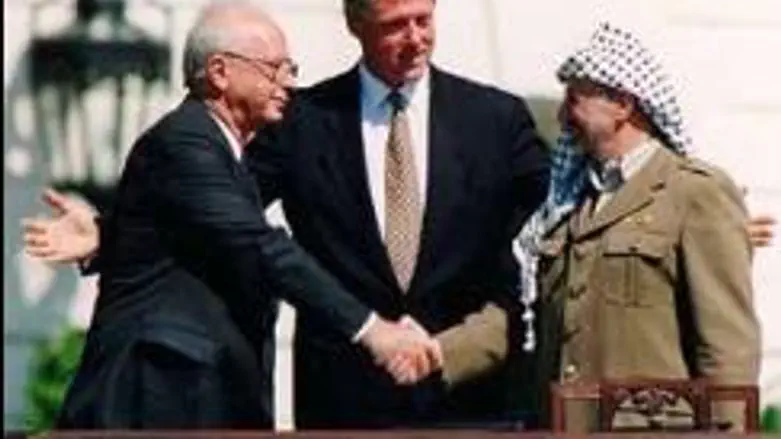
Dozens of politicians and former senior military staff gathered on Har Herzl in Jerusalem on Tuesday afternoon to pay respects to former Prime Minister Yitzchak Rabin, 13 years after his assassination. Several of those present spoke against the political right, and warned that “nationalist violence” could lead to more assassinations.
One of the more dramatic speeches was given by Minister of National Infrastructure Binyamin (Fuad) Ben-Eliezer, who told the crowd that another assassination was looming in the near future. “The writing is on the wall again, and this time the letters are bigger. The next political murder is around the corner.”
"Somewhere out there in the land of Israel someone is already holding a loaded weapon, and someone is giving him religious inspiration and the sense that he's on an ideological mission,” Ben-Eliezer continued. “You can't imagine the loathing that's been sown among the extreme Right, the bubbling hatred of the state of Israel, of Israeli democracy, the Knesset, the government and its elected officials, even of the army,” he said.
Former IDF Chief of Staff Amnon Lipkin-Shahak expressed concern for the safety of IDF soldiers. “I fear that one day someone will just pick up a weapon and shoot them. Whoever is not afraid as I am is simply naïve,” he said.
Lipkin-Shahak blamed Rabin's death on those who vehemently opposed the Oslo process he led. “I remember those who shouted 'murderer' and 'traitor'... there was always just a 'handful,' but it turned out that they grew,” he said.
Rabin's sister Rachel Rabin-Yaakov and Professor Ze'ev Sternhell spoke at the event as well.
Ben-Eliezer Slams Media
After criticizing “right-wing extremists,” Minister Ben-Eliezer sharply criticized the media for interviewing Rabin's assassin, Yigal Amir. Amir was recently interviewed by Channel 2 and Channel 10. As punishment, he was transferred to a different prison, and his telephone privileges and visitation rights were revoked.
Ben-Eliezer accused the media of “cynicism” and “ratings worship.” Amir should have been completely isolated following the killing, he said, with no information from the outside world and no ability to visit his family or speak to outsiders.
Despite criticism, Channel 10 decided to air the interview with Amir. Among other things, Amir said he was not influenced by religious leaders when deciding to kill Rabin. When asked who influenced him before the killing, Amir said those who motivated him most were senior politicians and military officials. “[Ariel] Sharon, Raful [Former Chief of Staff Rafael Eitan—ed.], Ghandi [Minister Rehavam Ze'evi—ed.], all of those who understood the military aspect, who said this accord [Oslo] would bring disaster.”