
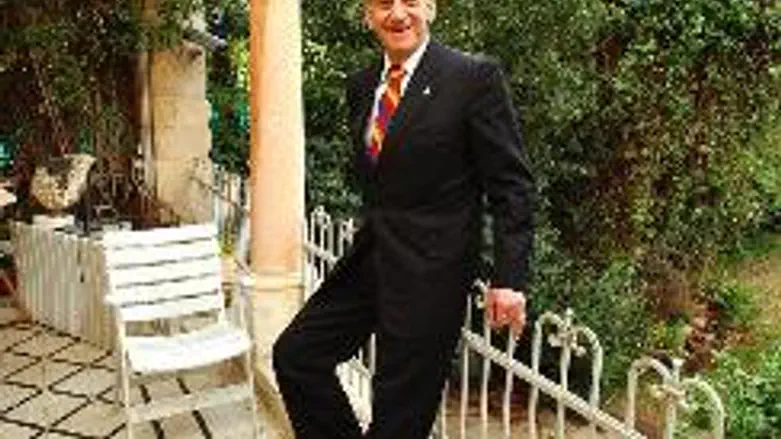
Ehud Olmert's troubled premiership featured a failed war effort, a series of criminal investigations against him, and repeated calls to resign.
Milestones in Ehud Olmert's Prime Ministerial career:
Feb. 1, 2006 - After calling off talks on a possible compromise, Olmert approves destruction of nine houses in Amona, near Ofrah, amidst the wounding of hundreds of protestors and policemen.
June 25, 2006 - IDF soldier Gilad Shalit was kidnapped by Hamas-affiliated terrorists and taken via underground tunnel to Gaza. Olmert says, "Israel sees the Palestinian Authority, headed by Abu Mazen and the PA government, as responsible for it, with all that is implied thereof." 
Born: Sept. 30, 1945, in Binyamina. He and wife Aliza have four children.
July 12, 2006 - IDF soldiers Ehud Goldwasser and Eldad Regev were kidnapped - and apparently killed immediately or shortly afterwards - by Hizbullah terrorists into Lebanon. Israel goes to war to return the soldiers and to destroy Hizbullah's terrorist infrastructure; neither goal is met.
Aug. 11, 2006 - The final 60 hours of the Second Lebanon War begin, during which Olmert orders a ground offensive aimed at dealing a strong blow to Hizbullah but which ends up costing 35 soldiers' lives. Olmert was later harshly criticized for this decision.
Education: B.A. & LL.B., Hebrew University of Jerusalem - Psychology, Philosophy and Law
Aug. 13, 2006 - Cabinet approves UN ceasefire agreement in Lebanon, though the two soldiers are still being held and presumed to be alive and Hizbullah is not disarmed.
Aug 28, 2006 - State Comptroller accuses Olmert of nepotism and arranging jobs for Likud Central Committee in the Ministry of Industry and Trade that he headed in the Sharon government, in exchange for their political support.
Jan. 3, 2007 - Olmert's Bureau Chief Shula Zaken is restricted to house arrest over a major tax and bribe scandal.
Jan. 17, 2007 - State Prosecutor Eran Shendar orders Israel Police to launch a criminal probe against Olmert for allegedly using his former position as finance minister to help two friends who were interested in buying the government's shares in Bank Leumi.
Jan. 2007: Investigations underway against Olmert in two other affairs: Alleged illegal appointments at the Israel Small and Medium Enterprises Authority during his tenure as minister of Industry, Commerce and Labor; and his purchase of a luxury apartment on Cremieux Street in Jerusalem at a large discount, allegedly in exchange for zoning favors on behalf of the Jerusalem Municipality.
Knesset Member: From 1974 onward, with a 4.5-year break from 1998 until 2003 when a law was passed preventing mayors from serving in the Knesset.
April 26, 2007 - State Comptroller details suspicions of criminal activity by Olmert when he was Minister of Industry, Trade and Labor, allegedly using his influence to obtain 26 million shekels worth of grants and benefits for a factory headed by his friend's clients.
May 1, 2007 - Interim Winograd Commission report harshly criticizes Olmert and government for Second Lebanon War decisions: "There was a weakness in strategic thinking... They went into war without thinking how they would get out of it." Many, including Foreign Minister Tzipi Livni, call for Olmert to resign.
July 18, 2007 - State Comptroller report blames Olmert and government for having "gravely failed in dealing with the Home Front during the Second Lebanon War."
Sept. 6, 2007 - Successful air strike against a nuclear reactor in Syria. Official Israeli position: "No comment."
Nov. 28, 2007 - Annapolis Summit: Olmert agrees to "address all the issues that have thus far been evaded. We will not avoid any subject." The reference was specifically to Jerusalem and the Arabs' demand for 'right of return' of millions of Arabs to Israel. The day before, with the future of Jerusalem in the backdrop, Olmert informed American Jewish leaders that "the government of Israel has a sovereign right to negotiate anything on behalf of Israel."
Mayor of Jerusalem: 1993-2003. Served as Minister of: Health; Industry, Trade, and Labor; Communications; Finance.
Jan. 16, 2008 - With indications strongly showing that Israel and the Palestinian Authority are negotiating the division of Jerusalem, Yisrael Beiteinu (Israel Our Home) quits the government coalition (which it had joined just 15 months before) while Shas - also under strong pressure to leave - remains.
Jan. 31, 2008 - The final Winograd Committee report examining the government's performance in the Second Lebanon War finds "serious faults and defects in the decision making processes in both the political and the military levels and the interface between them." The report laid the blame "mostly with the military," but added, "Partially responsible was the weakness projected by the political echelon."
May 26, 2008 - Economy doing well: Israel's Gross Domestic Product grew by an annualized 5.4% in the first quarter, and the shekel becomes an internationally recognized currency.
Interim or Acting Prime Minister: Jan. 4 - May 4, 2006; Sept. 21, 2008 and onwards. Prime Minister: May 4, 2006 - Sept. 21, 2008
May 27-28, 2008 - American philanthropist Moshe Talansky testifies about the tens of thousands of dollars he gave Olmert for his campaigns, saying, "He asked for cash." Defense Minister Ehud Barak issues near-ultimatum for Olmert to resign.
June 5, 2008 - Amnon Rosenberg of Kibbutz Nirim in the Negev is killed by a Kassam rocket - the 4th Hamas rocket casualty in the past 100 days. Sderot has been hit by many hundreds of rockets during Olmert's tenure, and its mayor even briefly resigned in protest. "As it appears now," Olmert told reporters, "we are close to a [military] ground operation in Gaza." Two weeks later, a ceasefire with Hamas is announced.
June 11, 2008 - Olmert approves primaries in Kadima to choose his successor, though he does not promise not to take part in the election himself.
July 30, 2008 - Olmert announces he will not run in the primaries.
Sept. 14, 2008 - Heading his second-to-last Cabinet meeting, Olmert states, "The notion of a Complete Land of Israel no longer exists, and anyone who still believes in it is deluding himself."
Sept. 17, 2008 - Tzipi Livni elected in party primaries to head Kadima.
Sept. 21, 2008 - Ehud Olmert submits resignation as Prime Minister. He remains head of the caretaker government until a new government is formed, which could theoretically take up to 6-7 months.
Born: Sept. 30, 1945, in Binyamina
Education: B.A. & LL.B., Hebrew University of Jerusalem - Psychology, Philosophy and Law
Knesset Member: From 1974 onward, with a 4.5-year break from 1998 until 2003 when a law was passed preventing mayors from serving in the Knesset.
Mayor of Jerusalem: 1993-2003
Government Roles: Minister of Health; Minister of Industry, Trade, and Labor; Minister of Communications; Minister of Finance.
Interim or Acting Prime Minister: Jan. 4 - May 4, 2006; Sept. 21, 2008 and onwards.
Prime Minister: May 4, 2006 - Sept. 21, 2008