

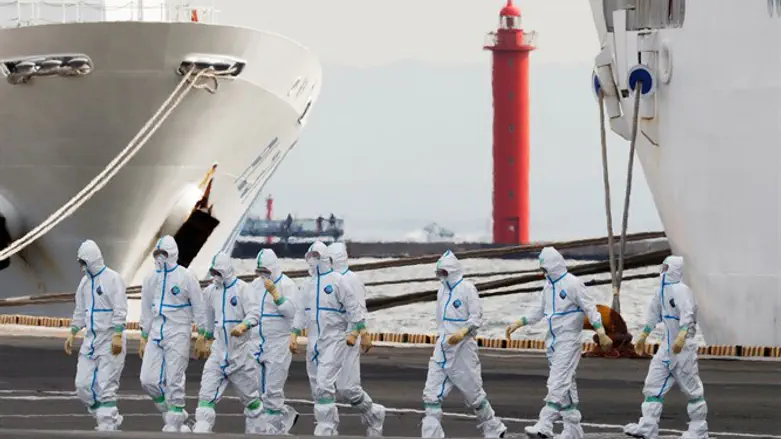
Traces of coronavirus remained inside cabins of the Diamond Princess cruise ship for more than two weeks after the cruise ship was vacated, according to a report released by the U.S. Centers for Disease Control (CDC) on Monday and published in ABC News.
Researchers who studied the ship, which docked in Japan on February 5th and was placed in quarantine for more than two weeks after several passengers and crew contracted COVID-19, determined that there were still traces of SARS-CoV-2 RNA present inside cabins a full 17 days after the 3,711 passengers and crew had disembarked.
The cabins had not yet been sanitized at that point, and CDC researchers said it was too early to draw conclusions from the data.
In February, toward the beginning of the outbreak, passengers on the Diamond Princess represented the largest cluster of coronavirus cases outside mainland China, with 712 people aboard the boat contracting the virus. CDC researchers found that 46% of the infected passengers and crew members were asymptomatic at the time of testing. The report added that roughly 18% of infected persons never developed symptoms.
"A high proportion of asymptomatic infections could partially explain the high [infection] rate among cruise ship passengers and crew," the report said. Other accounts of life on the quarantined ship noted that even after the virus was known to be spreading, some of the cruise ship’s staff and particularly those responsible for food preparation continued to have contact with the passengers and each other, leading many to criticize the way in which the crisis was handled on the ship. Dr. Anthony Fauci, director of the US National Institute of Allergy and Infectious Diseases and one of President Trump’s chief advisers in the coronavirus crisis, told USA Today that “the quarantine process failed,” on the Diamond Princess.
The CDC cited a number of factors that facilitated the dramatic spread of infection, including the mingling of passengers from several regions of the globe. Although most of the passengers have since been repatriated, 11 are still in Japanese hospitals, with seven of them in serious condition.