

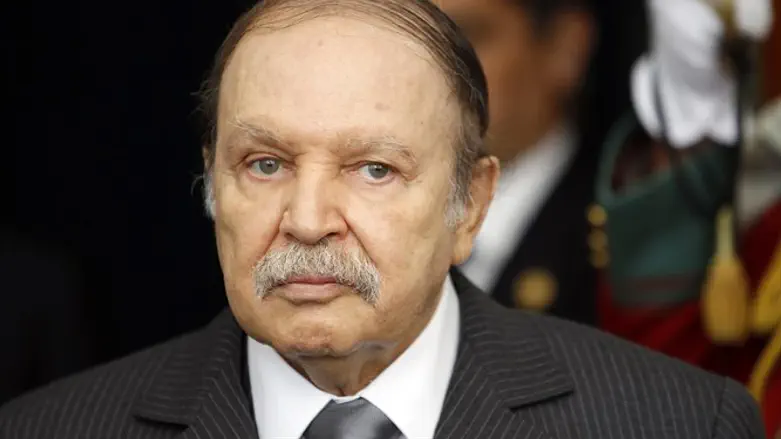
It’s official: Algerian President Abdelaziz Bouteflika on Tuesday submitted his resignation with immediate effect, AFP reported, Algerian citing state television.
Bouteflika "officially advised the Constitutional Council of the end of his term of office as President of the Republic" from Tuesday, said a news ticker on the public broadcaster.
Long accused of clinging to power, Bouteflika has come under mounting pressure to step down since his decision to seek a fifth term despite rarely being seen in public after suffering a stroke in 2013.
Tuesday’s announcement follows a report on Sunday that Bouteflika was preparing to announce his resignation in accordance with article 102 of the constitution, which allows a constitutional council to declare Bouteflika unfit for office or he can resign himself.
On Monday, it was reported that he would resign before his mandate expires on April 28.
The 82-year-old, who uses a wheelchair, said last month he would pull out of the bid for another term.
The moves failed to satisfy protesters who feared a ploy to extend his rule and the armed forces chief called for him to leave power.
His resignation was also reported by the official APS news agency, which said Bouteflika had "formally notified the head of the Constitutional Council of his decision to end his term of office".
Algeria was one of the countries to be hit by protests during the so-called “Arab Spring” in 2011, and hundreds were arrested by riot police as they called for the Bouteflika’s resignation.
Bouteflika subsequently lifted a state of emergency that was imposed in 1992, as Islamist militants waged war over the government's decision to ignore elections that gave a majority to a Muslim party.
Although credited with helping foster peace after Algeria's decade-long civil war, Bouteflika has faced criticism for alleged authoritarianism. He became president in 1999, and has clung on to power despite his ill health.
He was elected for a fourth term in April 2014 with 81.5 percent of the vote, despite not campaigning.
Car horns sounded in the street as small crowds of people began gathering to celebrate in Algiers.
The United States said the future of Algeria was now up to its people.
"Questions about how to navigate this transition in Algeria, that is for the Algerian people to decide," State Department spokesman Robert Palladino told reporters, according to AFP.
Algeria's constitution says that once the president officially resigns the speaker of the upper house of parliament would act as interim leader for up to 90 days during which a presidential election must be organized.
The resignation came shortly after the military demanded impeachment proceedings be launched against Bouteflika immediately as it dismissed the announcement he would resign before his mandate expires.