
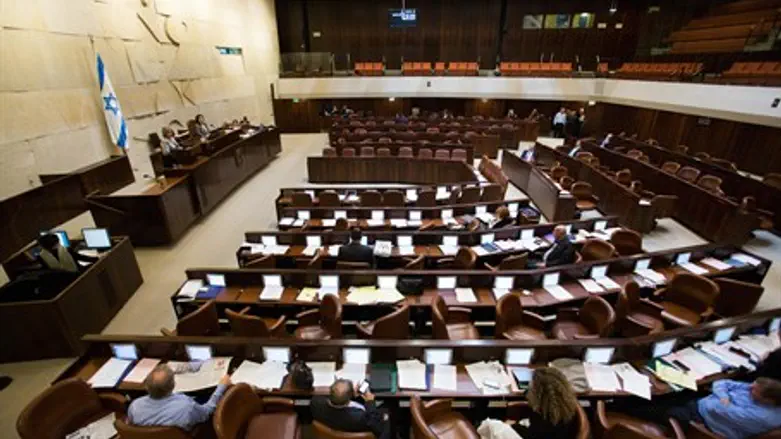
The Knesset, which celebrates 50th years in its current location in Givat Ram in Jerusalem on Tuesday, is facing one of its darkest hours in Israeli history.
According to a recent poll conducted by Army Radio, overwhelming segments of the population feel disconnected from the Knesset and believe that the politicians who work there do not represent them.
According to the poll 76 percent of the populace feel that the members of the Knesset worry about themselves and their own careers more than they care about the public interest. Add on to that number the 69 percent of people who responded to the poll believe that the multiple ministerial positions held by the Prime Minister harm the democratic nature of the country, we find that the Knesset is not doing well in the eyes of the public.
Other results that came up in the poll suggest that the majority of Israelis want a balanced and equal society between Jews and Arab as well as between religious and secular. 43 percent of those who responded wanted equal rights for Israeli Arabs, while 45 percent did not. Another twelve percent were either undecided on unsure. At the same time 47 percent wanted a country that identifies itself as Jewish and Democratic, and while 41 percent felt it was too Jewish and not democratic enough, 30 percent felt it was too democratic and not Jewish enough. Only 22 percent felt that the country currently has the right balance.
On a positive note, 47 percent of those who responded felt that President Reuven Rivlin is doing a good job in fulfilling his role, as opposed to the 38 percent who feel that he is not doing an adequate job.
But the most worrying part of the poll, and overall the most sweepingly agreed upon by members of all parts of Israeli society was the fact that the majority of Israelis feel that the Knesset, even with it’s ten different factions, does not represent them or their interests. A whopping 84 percent of those polled feel that the Knesset does not represent them or their values.
That staggering number shows a clear sense, even after taking into consideration the margin for error, that the majority of Israelis feel that the Knesset as it is currently working, is highly problematic, and that the MK’s and factions that make up both the government as well a s the opposition have a long way to go to regain public trust.
With a voter turnout of 71.8 percent in the last election, the highest in almost 20 years, the public is clearly engaged, or at least they were. However, with the statistics as they are now, the question arises as to whether or not the public will stay interested and whether or not they will come out to vote in the next election, especially if they feel that there is no one on the spectrum who will adequately represent them.