
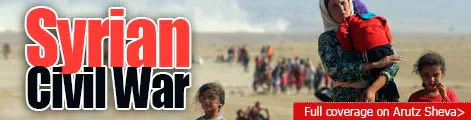

Lebanon's government has decided to enforce new regulations preventing the mass entry of refugees fleeing the civil war in Syria.
The new policy requires Syrians to obtain specific visas divided by category - including tourism, business, education and medical care - to enter the country. The visas also severely limit the amount of time the refugees can remain in Lebanon.
Previously, Syrians were given six-month visas and many were able to cross the border without any paperwork.
The Syrian civil war, which shows no signs of stopping, has displaced a third of Syria's overall population.
Over three million people have fled, mainly to neighboring Lebanon, Turkey, Jordan and Iraq. A small number of refugees have been permitted refuge in European countries, while hundreds more have drowned on the way by attempting to cut across the Mediterranean sea on rickety smuggler ships.
Lebanese officials estimate there are about 1.5 million Syrians in Lebanon, marking one-quarter of the total population. The United Nations refugee agency places the number at 1.1. million.
According to officials, they are simply unable to absorb anymore immigrants.
"We have enough. There's no capacity anymore to host more displaced," Interior Minister Nohad Machnouk said during a press conference.
Many Syrians were already being turned back at border crossings Monday, but the exact figures are not known.
In 2011, when the civil war began, the refugees that poured in began to overwhelm the country's water and power supplies, pushed up rents, and depressed the economy in rural areas by forcing impoverished Lebanese to compete for scarce jobs.
Lebanon is already home to hundreds of thousands of Palestinian refugees who sparked a sectarian civil war from 1975-1990. Many fear that an influx of Sunni refugees could escalate tensions between Sunni Muslims and Shiites.
"Accepting more refugees could undermine the fragile balance among the different sectors that make up Lebanon," the government said.
Ron Redmond, a spokesman for the United Nations Human Rights Council said, "We are looking at these new procedures with some interest, because those procedures don't make mention of the agreement of the government to continue to allow the most vulnerable cases to come through."
"We demand that the urgent cases, such as single mothers fleeing with children, or those needing medical care, be allowed to cross the border."
"We didn't see any reference to that in these new regulations," Redmond said. "We want to get some kind of official documentation and description of how that's going to work."