
Leftist politicians and activists are angry over a recent spate of legislation which they see as limiting their freedom of speech and political activity.
The latest bills to arouse the Left's ire are ones that, if passed, would limit the ability of foreign governments and international bodies to fund Israeli political NGOs. Also on the agenda is a law that would require Supreme Court nominees to undergo a parliamentary vetting process.
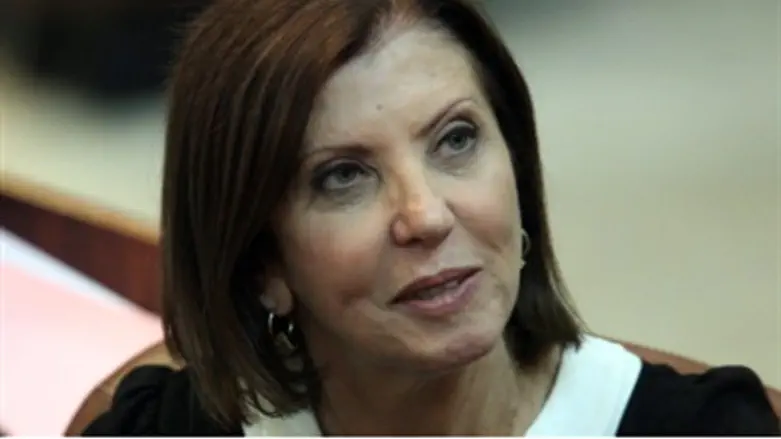
Foremost among the voices crying foul is that of MK Zehava Galon (Meretz). "The bills raised at the Ministerial Committee for Legislation poison democracy even without being voted upon," she stated Sunday. "Just by being presented, they encourage violence against activists for human rights and peace, strike terror into hearts and encourage self-censorship, which we are already witness to in several media outlets."
Interestingly it is Galon herself who, as leader of the Meretz faction, was instrumental in the court petitions that led to the State's shutting down of Arutz Sheva Radio eight years ago.
Arutz Sheva had broadcast for 14 years from a ship anchored at sea -- unfettered by centralized political regulatory procedures -- and was very popular among Israeli nationalists as the only alternative to mainstream leftist stations. An ultra-leftist station named the Voice of Peace had broadcast in precisely the same way for three decades, unmolested. Some feel that the government was already making preparations for the Disengagement from Gaza and possibly did not want Arutz Sheva making trouble.
As the High Court debated the motions against Arutz Sheva and eventually found in their favor, Galon and other Meretz heads repeatedly demanded that the Attorney General order Arutz Sheva closed down, their much-touted belief in free speech notwithstanding. Eventually, this is exactly what happened, on October 20, 2003.
A few weeks later Galon launched an attack on Arutz Sheva's sole remaining means of expression – its internet website (the one you are currently reading).
The article in question, by Gil Ronen, assumed that since there is no chance for reaching peace with the Arabs of Yesha (Judea and Samaria), Israel has no alternative but to "remove this 'nation' from our midst." Ronen wrote that he does not support "transfer," as "the Palestinians are not European Jews, and we are not Germans." Instead, he painted a scenario of "gradual deterioration" in which the war against terrorists expands to include more targeted killings, more house demolitions, and more air raids. All of the actions envisioned in the article were depicted as being taken by the IDF. As Arutz Sheva noted at the time, Ronen specifically wrote that "no one will have to take the law into his own hands."
AG Rubinstein accepted Galon's demands and ordered an investigation against Arutz Sheva. The investigation was closed after police found no grounds for prosecution.
Analyst Ariel Natan Pasko noted at the time that Galon was not just after Arutz Sheva's freedom of speech: "Clump-clump, clump-clump, clump-clump, hark, I hear the sound of the goose-stepping Bolshevik Israeli thought police in the distance," he wrote.
MK Zahava Gal-On, just a couple of months ago, asked the Attorney General to look into a Jerusalem Post editorial she said had "words of incitement to murder" in it. The Jerusalem Post editorial said, "The world will not help us; we must help ourselves. We must kill as many of the Hamas and Islamic Jihad leaders as possible, as quickly as possible, while minimizing collateral damage, but not letting that damage stop us. And we must kill Yasser Arafat, because the world leaves us no alternative." Where is Freedom of the Speech? Where is Freedom of the Press? When was it ever "incitement to murder", to call for the death of the enemy in wartime? Only in Israel, only on the Bolshevik Left, only to shut people up and divert attention from discussing the real issue, Arafat's war against Israel. By the way, in the end the Attorney General found nothing prosecutable in the editorial. Freedom of Speech 1, Thought Police 0.
Eight years down the line, it is Galon who claims that the nationalists are the ones guilty of censorship -- and that her camp is the victim being stifled.