
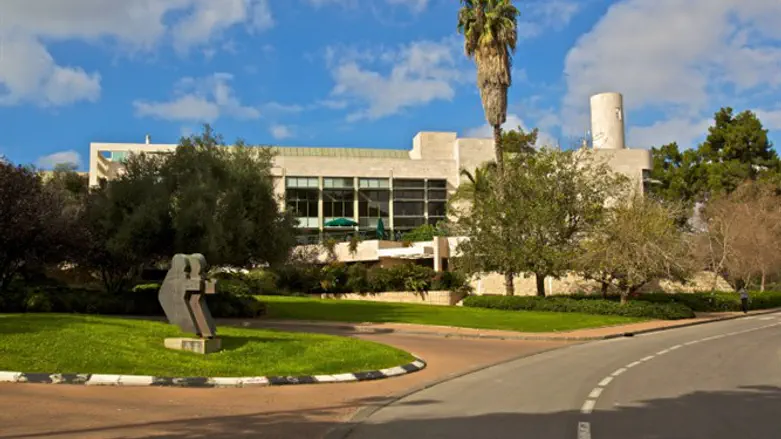
Israel, the start-up nation, is also a leader in many fields of research, and its young scientists, contagiously excited about their fields, are the smiling face of those endeavors. Arutz Sheva brings you a glimpse at young doctoral candidates at the Weizmann Institute, some on their way to the USA for a goodwill Scientists of Tomorrow tour in March and others attending a highly prestigious international conference.
We have tried, with their help, to briefly define their research in ways understandable to ourselves and readers, but stand amazed at the level reached by these youngsters, among them both sabras and immigrants, all raised in the Jewish state.
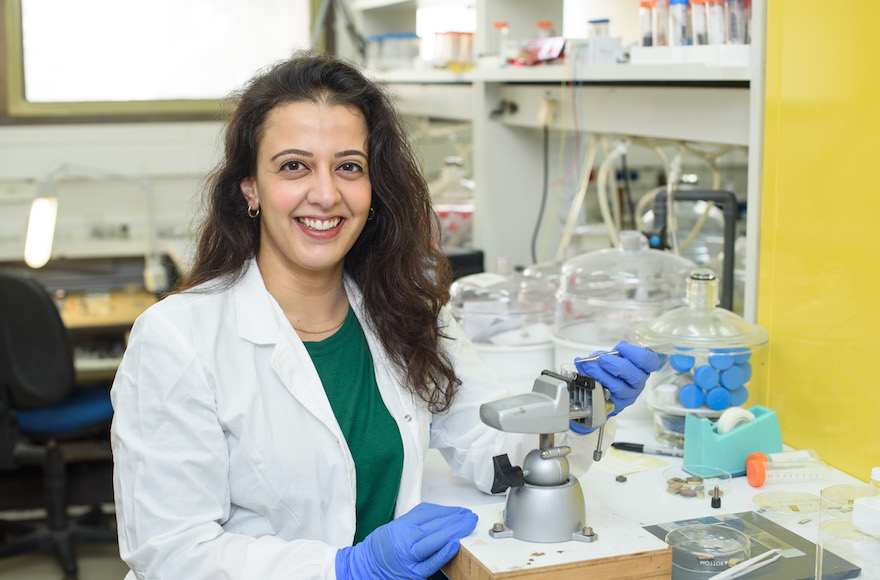
Elena Meirzadeh, pursuing her doctorate at the Weizmann Institute of Science, is studying the properties of crystals with an eye toward applications ranging from airplane wing deicing to improving cloud-seeding techniques to increase rainfall. (photo courtesy of Weizmann Institute)
Meirzadeh, who immigtrated from Iran with her family at the age of 12, is now pursuing her doctorate at Weizmann’s Feinberg Graduate School, working in the Department of Materials and Interfaces, examining how defects and imperfections influence the properties of crystals.
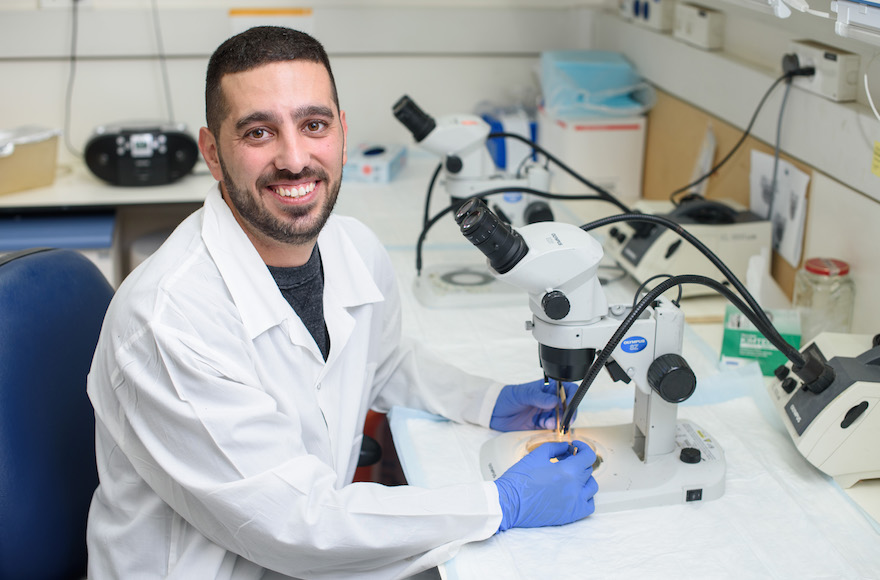
Doctoral student Amitai Mandelbaum of the Weizmann Institute of Science is examining how abnormal microRNA behavior may contribute to the development of diabetes. (photo courtesy of Weizmann Institute)
Mandelbaum,, a doctoral candidate in molecular genetics, is studying microRNAs – small, non-coding molecules that regulate gene expression. He is examining the role of microRNAs in normal cell function, as well as how abnormal microRNA behavior may contribute to the development of diabetes.
Heli Ben Hamu, now pursuing a master’s degree in computer science and applied mathematics, is focused on geometric deep learning, a relatively new field with significance for artificial intelligence. She is developing a neural network that generates 3-D models of the human body – work that has practical applications for the development of self-driving cars and the interpretation of medical images.
Shir Nevo is a Weizmann doctoral student in immunology, studying the molecular basis of auto-immunity, a misdirected immune response where the body attacks its own tissues.
Quantum computing is Tom Manovitz’s expertise. A doctoral candidate in Weizmann’s Department of Physics of Complex Systems, Manovitz is working further to isolate and control individual atoms in order to better understand and utilize the quantum-mechanical behavior on which future quantum computing may be based.
Efrat Resnick, a doctoral candidate in chemical biology, is working on ascertaining more efficient ways of discovering and evaluating the compounds that offer specific biochemical benefits, particularly compounds that attach irreversibly to proteins and thereby produce long-lasting medicinal effects.
All six are part of the Scientists of Tomorrow tour.
International Symposium in Savannah, Georgia
Professor Gershom Martin, recipient of the 2017 Israeli Chemical Society Prize for Excellence and Dr. Mark Iron, young researcher in Weizmann Institute's Computational Chemistry Department are being accompanied by another young doctoral student, Nitai Sylvetsky, all three representing Israel at the annual Sanibel Symposium for Theoretical Chemistry, the largest conference in the world on the subject, currently taking place on Sansimon Island, Georgia.

They will be meeting colleagues from all over the world, enriching and sharing Israeli knowledge in the field of Theoretical and Computational Chemistry, a field which carries on the legacy of chemistry as a bridging science – but uses physics and computational tools, rather than the laboratory, to explain the properties of materials, solids, and also of biological phenomena.
Sylvetsky, a graduate of the Ohr Torah Neve Shmuel Yeshiva High School in Efrat. did his IDF service in the Intelligence Corps in the framework of the hesder yeshiva program at Otniel and Siach hesder yeshivas before beginning his studies at the Weizmann Institute.
He explains some of the exciting challenges of the doctoral research in which he is engaged to Arutz Sheva : "Many biochemical systems of vital importance, such as enzymes and various proteins, rely on subtle and complex quantum phenomena in order to perform their functions. What is called ab initio quantum chemistry methods are nonempirical computational chemistry approaches based on rigorous theoretical postulates of quantum mechanics, and a central goal of our research is to investigate whether these much more accurate methods of computation can be used to shed light on certain biomolecules and their reactions."
"For example," he continues, "enzymes are 'molecularmachines’ found in living organisms and as we know, play crucial roles in important biological-physiological processes which are still not completely understood. Enzymes pose an exciting challenge to theoretical chemists, due to the fact that they take advantage of various quantum effects in the process of binding to the molecules on which they act."
"State-of-the-art quantum chemical methods of computational chemistry hope to provide the appropriate tools for shedding light on the mechanisms by which enzymatic binding works, with possibly far-reaching results for humanity," he adds, the last phrase explaining what makes all these young Israeli adults so full of enthusiasm for their work.