
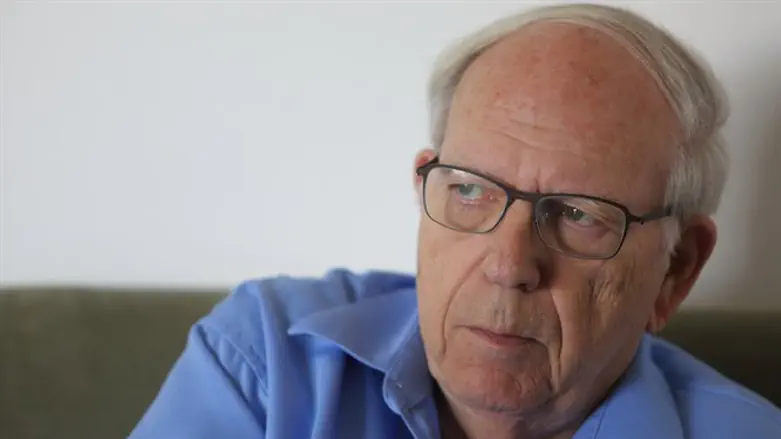
The ninth chief of the Mossad, Ephraim Halevy, spoke today at the Schechter Center in Jerusalem which, in these days, is hosting a delegation of senior legal experts from Canada.
Halevi addressed relations between “the three points of the triangle:” Israel, the US, and Russia. “I don’t think that Iran was, or will ever be, an existential threat to the State of Israel. More and more people are starting to think like this,” Halevy said.
He added that this assumption does not mean that we do not need to take every step to prevent Iran from obtaining nuclear weapons: “Israel cannot be destroyed.”
“If we have not succeeded in these past 70 years to create a certain degree of security that will help us in the face of every level of danger, then I think we have failed in our mission. I hope that we will not have to put what we have achieved to the test, but I believe that Israel will survive every threat.”
Halevy praised the resilience that the State of Israel has shown over the years. “There is no intelligence agency or state in the world that has had to deal with the problems Israel has. I’m not saying we haven’t had failures - you can’t win them all - but we need to be very proud of ourselves. If, after the Holocaust, we lost a third of our people and still succeeded in rising from the dust and getting to where we have, nobody can threaten us, and we need to be sure of ourselves that we will survive.”
Halevy surveyed relations with the two world powers, the US and Russia, from the founding of the modern State until our present time. He showed how the former decision of the USSR not to support and aid the fledgling State of Israel laid the groundwork for relations between the two countries and was, further, a mistake from the Russian point of view.
“In 1972 the Russians understood that they had made a mistake in relations with Israel, because it prevented them from getting a foothold in the region. In any event, the US and Russia will be around for many more years, and the bottom line is that we need to decide how we, with wisdom and efficiency and caution, will manage our relations with these world powers that stand to be around for many years to come.”
Halevy added that the strategy for conflict management in the Middle East needs to be such that it doesn’t strive to bring the conflict to a close, but rather to manage the conflict in the most efficient way. “We need to forget about the cliches inherent in our approach. We don’t need to bring conflicts to a close, but to live with them and, to this end, reevaluate our strategy.”