


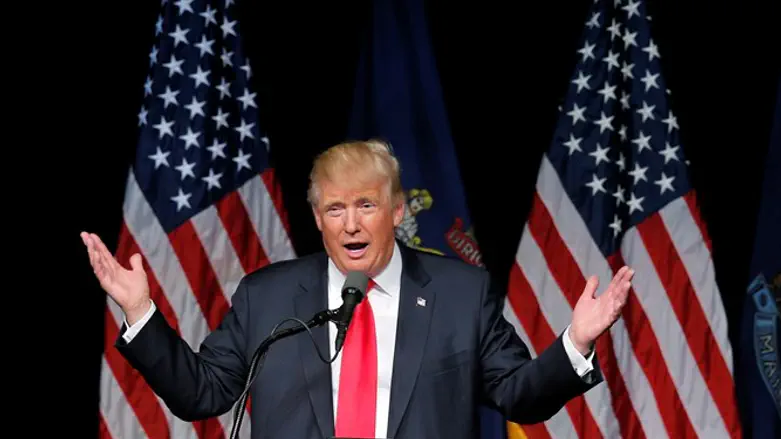
The polling as of late is admittedly fairly bleak for the Trump campaign. The latest RealClearPolitics average of polls has Donald Trump down six points, 41.2% to 47.2%.
In state polling, things look even worse, with Trump trailing by double digits in Colorado (35.6% to 46.4%) and Virginia (37.8% to 49.0%), and by more than 9 points in Wisconsin (37.3% to 46.7%) and Pennsylvania (40.0% to 49.2%).
Even in North Carolina, which Romney won in 2012, Trump trails by two points.
But all is not lost – at least not yet – say experts, who argue the Republican nominee still has time to close the gap on former Secretary of State Hillary Clinton.
Despite Trump’s relatively poor polling at this stage, there are a number of reasons leading prognosticators are refusing to call the election in Clinton’s favor early on in the cycle.
First, there’s still a great deal of uncertainty in the polls. Both Trump and Clinton have high unfavorable – they’re actually the first and second most unpopular major party presidential candidates since polling began.
When the full ballot is considered, giving respondents the option of voting for other candidates, Clinton gets remarkably low figures for a frontrunner, averaging just 43.5% - more than a point below where Mitt Romney was polling at this point in 2012 and 3.7% less than what he received in the election.
Third party candidates Jill Stein and Gary Johnson – particularly the latter – are also pulling in surprisingly large numbers. The two average a combined 11.4% - 8.3% for Johnson, 3.1% for Stein, and Johnson has even hit double digits in some polls.
While its possible Johnson, who is likely benefitting heavily from Republicans frustrated with Trump, could make historic gains this election, the Libertarian Party has never exceeded 1% in a presidential election. There is a strong possibility that many disaffected Republicans will come home to the GOP on election day, despite their misgivings about the party’s standard bearer.
The polling analysis site FiveThirtyEight cautioned against decisive predictions at this point, noting that while the economy was “decent”, it does little to boost the incumbent party.
Post-convention polling has been a good predictor for the election outcome, FiveThirtyEight commentator Harry Enten admitted, but added that on average they’ve differed from the actual results by nearly 5 points.
Prior to Labor Day, polling remains relatively fluid, giving Trump the opportunity to find new momentum.
And then there are the prediction models, used by political scientists to gauge the likely outcome of elections months in advance.
Some, like the Economic Indicators & Polls model shows Clinton beating Trump – by four points, to be precise, and has a 75% level of confidence.
The Political Economy model also shows Clinton winning, with a 83% level of confidence, albeit by just 2.2 points.
Others, however, show a dead heat, with the Economic Expectations and Political Punishment model predicting a virtual tie, 50.4% to 49.6% in Clinton’s favor.
But two models, the Time for Change model and Primary model show Trump the odds-on favorite to win in November.
The latter model shows Trump winning by a comfortable margin of 5 points, and has an 87% level of confidence. This model has correctly predicted every election since it was first employed in 1996.