
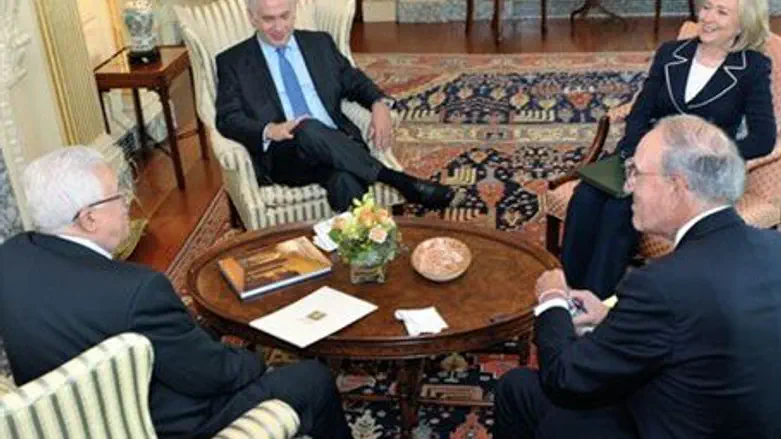
U.S. Secretary of State Hillary Clinton will lead talks between Israel and the Palestinian Authority in Egypt on Tuesday, before taking the traveling American “talk show” to Jerusalem and 13 days before Israel's temporary 10-month building freeze is to end.
Abbas has won American support for an extension of the freeze on building of homes for Jews living in Judea and Samaria, but Prime Minister Netanyahu this week played the “Jewish State” card. Abbas’ refusal to characterize Israel as a Jewish State while calling for “two states for two peoples” may weaken the American case that Israel continue the freeze, which has been a "red line" for Abbas.
However, the Obama administration so far has not publicly pressed the PA to do anything other than to continue talks, regardless of the status of the freeze. Clinton told reporters on her plane en route to Egypt, “The United States believes that the moratorium should be extended."
She did not make any clear demands from the Palestinian Authority, except to state, "This has to be understood as an effort by both the prime minister and the president [Abbas] to get over the hurdle posed by the expiration of the original moratorium in order to continue negotiations.”
Even when a reporter at the State Department's daily briefing Monday pointed asked, “What is exactly expected of the Palestinians? I mean, how could they show seriousness in these talks?” spokesman Philip Crowley did not give any indication of what, if any, demands would be made from Abbas.
Instead, he reiterated the view that “we want to see the process continue, and we understand that both sides have staked out some certain positions. But at the same time, both sides have assumed a responsibility to create an environment in which these talks can continue and progress made and, ultimately, a successful negotiation completed."
Officials have lowered the profile for the discussions at the Red Sea resort of Sharm el-Sheikh, and Clinton may focus more on keeping up good spirits rather than discussing contentious issues. One indication of low expectations for upbeat statements from the second round of direct talks is that a scheduled press conference has been canceled.
The meeting is in sharp contrast to carefully choreographed meetings two weeks ago, when U.S. President Barack Obama played the role of peacemaker by getting Prime Minister Binyamin Netanyahu and PA Chairman Mahmoud Abbas to sit down and talk to each other for the first time in nearly two years.
However, PA officials downplayed positive statements by American officials, explaining that no substantial issues were discussed, with both leaders still trying to establish the “rules of the game.”
U.S. State Department officials have conceded that one of Clinton’s main tasks will be to try to change the attitudes on both the PA and Israeli sides before she meets with leaders in Jerusalem and Ramallah Wednesday.
Assuming that neither Israel nor the Palestinian Authority will want to risk being blamed for de-railing the discussions, U.S. President Barack Obama is expected to corner Prime Minister Netanyahu and Abbas next week at the United Nations General Assembly, which opens its new session Tuesday.
Obama's pitch may be the last one if the PA does not accept at least a partial thaw in the building freeze rather than recognize Israel as a Jewish state, a designation which would implicitly complicate Abbas' demand that Israel allow the immigration to Israel of several million foreign Arabs claiming ancestry in Israel. Netanyahu says they can go to a future Palestinian state.