
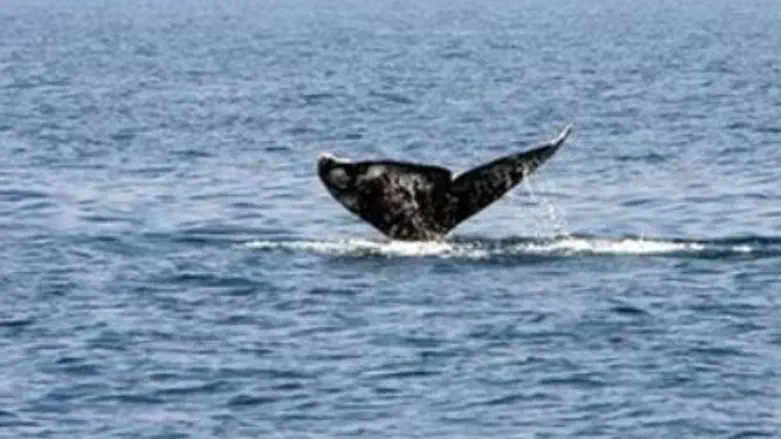
Scientists spotted a rare sight on Saturday off the coast of Herzliya, when a gray whale's tail suddenly appeared above the waves of the Mediterranean Sea.
The whale, a mature creature that measured approximately 12 meters (39 feet) and weighed about 20 tons, was thousands of miles away from home. It was about a mile and a half out from land.
How it got here, scientists can only guess. Sightings of gray whales have not been recorded in this part of the world for at least several hundred years.
According to Dr. Aviad Scheinin, chairman of the Israel Marine Mammal Research and Assistance Center, the creatures once swam in the northern Atlantic Ocean, but have not been seen since the 18th century.
The only existing gray whales today live in the eastern and western areas of the northern Pacific Ocean. One group of about 20,000 whales live in the eastern Pacific, commuting between Alaska and Baja, California. The only other group of gray whales in existence is comprised of fewer than 200 individuals living in the Siberian Sea of Okhotsk and South Korea. They are listed as critically endangered.
Scheinin told the AFP news service the cetacean probably arrived via the Northwest Passage, an Artic sea route connecting the Atlantic and Pacific Oceans. It is normally covered with ice; however, the ice in the Arctic is melting, and the passage is now completely clear.
Apparently the whale had traveled south around October with the rest of the population, which migrates from the northeastern Pacific towards the warmer waters around the Gulf of California.
“Instead of turning left to the Gulf of California it turned into the Mediterranean Sea through the Gilbraltar Straits and then traveled all the way to the eastern Mediterranean,” Scheinin said, ending up as a tourist to Israel.
The whale was “pretty thin” when it arrived, said Scheinin, “which indicates the trip was quite harsh, but we think it can survive here. Gray whales are very generalist in what they feed on.” Scientists are considering ways to track the whale by satellite, he said.
“The question now is, are we going to see the re-colonization of the Atlantic? This is a very important question,” said Scheinin, “because of the change of habitat. It emphasizes the climate change that we are going through.”
At last sighting, the whale was seen heading south past Yafo (Jaffa).
Phillip Clapham of the Seattle, Washington-based National Marine Mammal Laboratory commented to local Channel 4 News science correspondent Tom Clarke, “It is probably wondering where the hell it is.”