
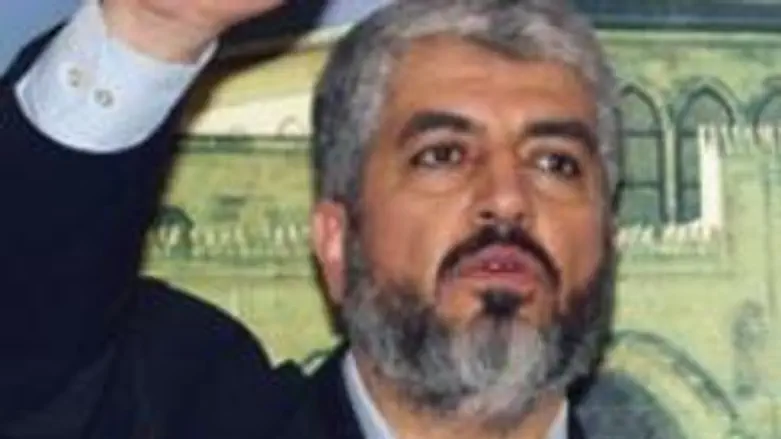

Masha'al also called on Arab leaders to use methods such as increasing the price of oil in order to force Western countries to tow the Arab line.  Although the Palestinian Authority is being represented at this weekend's Arab Summit in Libya by Mahmoud Abbas of Fatah, Hamas has its own agenda to present. In an interview with Arab satellite channel al-Jazeera, Hamas chief Khaled Masha'al said that the terror group has asked the leaders of the forum to discuss issues such as working out an arrangement with Fatah, protecting Muslim interests on the Temple Mount and in Jerusalem, ending the “siege” on Gaza, condemning the elimination of Hamas terrorist Mahmoud al-Mabhouh, and other items.
Masha'al laid out Hamas' diplomatic plan to resolve the Arab-Israeli conflict: A new Arab state in all of Judea and Samaria, with Jerusalem as its capital,the repatriation of the descendants of Arabs who fled Israel in 1948 to their previous homes (termed “the return of refugees” by Masha'al), removal of all Jews from Judea and Samaria, and full control of all areas and borders in the new state.
“We will not arrive at this solution without the use of real force and struggle,” he said. When asked whether Hamas would respond to the elimination of Mabhouh by an attack against Jews outside Israel, Masha'al responded that “Hamas' policies are well-known and we are capable of responding to the crimes of the Zionists.”
Masha'al called on Arab leaders to use methods such as increasing the price of oil in order to force Western countries to tow the Arab line. He called on the Arab leaders to “support the struggles of the Palestinian residents of Jerusalem through the adoption of a plan of action and the influence of the weight of the Arab and Muslim world in the economic and diplomatic spheres in its relations with the West, and to support the Palestinian people in its struggle against Israel”. In the interview, he also warned that the mosques on the Temple Mount were in “danger of collapsing due to Israeli archaeological work.”