
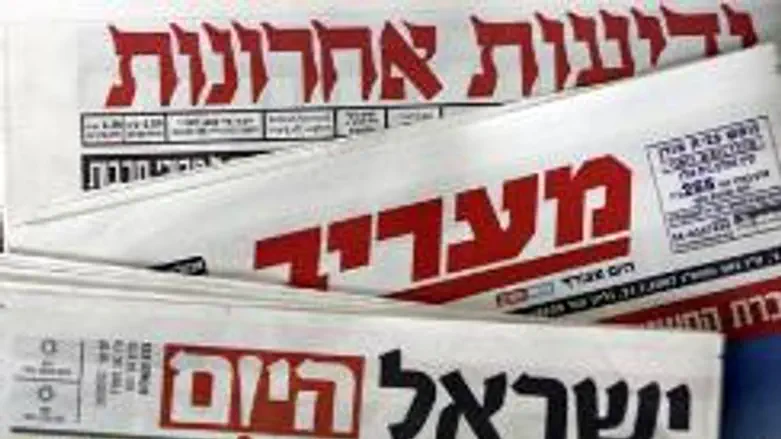
The battle between Israel's established newspapers and freebie newcomer Yisrael Hayom continues to occupy the media's opinion pages, and hence the public's thoughts. The weekly Hebrew B'Sheva magazine asked Caroline Click of the Jerusalem Post and Amnon Dankner, the former editor of Maariv, to give their opinions on the proposed law that would prohibit a foreign national from publishing a newspaper in Israel. The law is designed to prevent billionaire Sheldon Adelson from continuing to print Yisrael Hayom.
Caroline Glick, editor/columnist in the Jerusalem Post 
It is obvious to any clear thinking individual that the campaign for the Adelson Law is an attempt by Israel's media to seal off the market from competition. Were this not the case, Maariv would not have devoted a double spread in its Friday edition to the struggle against 'Yisrael Hayom.'
Among other things, the law's supporters try to justify their position by saying that a situation in which a foreign citizen puts out a newspaper is indistinguishable from one in which foreign governments act to influence Israel's moves by funding political groups like Peace Now. However, this claim is baseless. When foreign governments fund organizations like Four Mothers, the Geneva Initiative, Peace Now etc., they use subversive methods to influence public opinion and dictate Israel's diplomatic moves. Until recently, the general public was not aware of the fact that most of our supposedly grassroots leftist groups are no more than salaried agents of European governments and the US.
On the other hand, when a private citizen – Israeli or foreign – publishes a newspaper, everything is done 'over the table.' There is no hidden agenda here. There is no attempt to mislead. There is a person trying to spread a certain point of view and if the public agrees with him they will buy it. Otherwise they won't.
The fear that the media people harbor toward free competition is a reasonable one. After all, they know that the general public does not support their opinion and that once there are enough alternative media products, they will lose their influence on the state's decisions.
Amnon Dankner, former editor of Maariv
Let me say something that politicians usually say: this is not the real question. The real question is, can Israeli society  contain a phenomenon that has three components, each of which might be bearable on its own, but the three of which together pose a problem.
The first element is the freebie paper. The very existence of the freebie causes very problematic competition from the point of view of newspapers that are sold for money.
The second element is the huge and disproportionate power of the tycoon who is behind the freebie. This kind of power is disproportionate to the scale of the assets that players on the Israeli market possess.
The third element is that the freebie serves as an ideological, personal and party tool. After all, this freebie is all about Binyamin Netanyahu. And I must say, I have no problem with a newspaper that supports Binyamin Netanyahu. Nor do I have a problem with a freebie, and there have been some very good freebies. Nor do I have a problem with tycoons who come to Israel and want to do all kinds of things. I do have a problem with the combination of all three things, and that is what is so worrying.
I am not against the free market and capitalism, but I favor regulation where it is needed. A phenomenon like this, which could cause collapses in – and a possible failure of – the media market, cannot go by without a public discussion, and steps may have to be taken.
A varied and strong press is the life blood of democracy. And while I am not naïve enough to think that today's press is problem-free, it is still better than the alternative.