
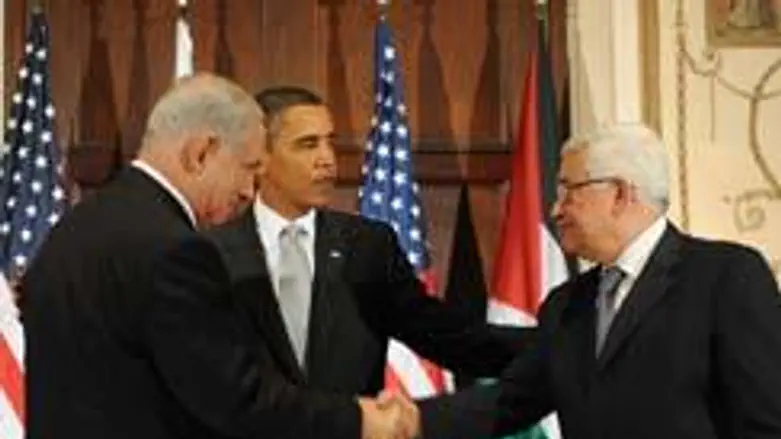
In what Israeli commentators said was a coup for Israel, Prime Minister Binyamin Netanyahu told reporters following his meeting with U.S. President Barack Obama and Palestinian Authority Chairman Mahmoud Abbas that Israel and the PA would begin negotiations soon, without a commitment from Israel to a building freeze in Judea and Samaria, as the PA had demanded.
Video: President Obama's Speech:
"There was general agreement, including on the part of the Palestinians, that the peace process has to be resumed as soon as possible with no preconditions," Netanyahu said.
"The importance of the meeting was actually its existence - in this case this common saying says a lot, because there was no contact for half a year," said Netanyahu. "This meeting brings back together people who have worked with each other for years, who have a real ability to change the face of the future."
The actual tripartite meeting lasted only approximately a quarter of an hour – much shorter than the meeting Netanyahu and Obama held prior to the "summit" itself. Prior to the meeting, Obama had said that he expected negotiations to begin in the near future. "Simply put, it is past time to talk about starting negotiations," Obama said. "It is time to move forward... Permanent status negotiations must begin and begin soon." Netanyahu said he expected the negotiations to begin in mid-October, at the earliest.
Foreign Minister Avigdor Lieberman observed pointedly that although the PA representatives said they would set no preconditions for negotiations, the reality was quite different. "The other side is demanding all sorts of steps in Judea and Samaria," he observed. Israel, he added, "has been ready from day one to sit down and immediately talk with all the sides and all the neighbors, without preconditions."
Abbas reiterated in a statement released to the media following the meeting that the PA confirmed its commitment to the Roadmap plan and its implementation. However, he added, "We also demanded that the Israeli side fulfill its commitments on settlements, including on natural growth. Talks could only be renewed, Abbas said, "based on our stated position" -- that is, the PA's insistence that Israel withdraw to the 1949 armistice line, also known as the Green Line, or the pre-1967 border.
For weeks, Abbas had said that he would not attend the summit unless Israel declared a halt to all construction in Judea and Samaria. Israeli commentators said that beginning negotiations without preconditions was a "slap in the face" to Abbas.
Channel One and Channel Ten television commentators focused on the details of the body language and phrases used by Obama, and how he related to Netanyahu and Abbas. Ayala Hasson of Channel One observed that Obama shook Netanyahu's hand more heartily than he did Abbas'. She said that the summit did not constitute a "victory" for Netanyahu, but that Netanyahu had at the very least ensured that his coalition would continue to survive, since the Prime Minister could claim that he had stood up to Obama and Abbas, refusing to declare a building freeze in Judea and Samaria, despite heavy pressure to do so.
On Channel Two, commentator Amnon Abramovich noted the language used by Obama to describe Israel's commitments. "The Palestinians need to do more in order to advance the negotiations. The Israelis have taken some steps, but they need to act to restrain activities in the settlements," Obama said. Abramovich noted the use of the term "restrain," as oppose to "halting," which the U.S. has previously used, and said that it was as if the U.S. had set itself as a traffic cop. "Instead of closing the road completely, they are asking Israel to drive slower," Abramovich observed.