
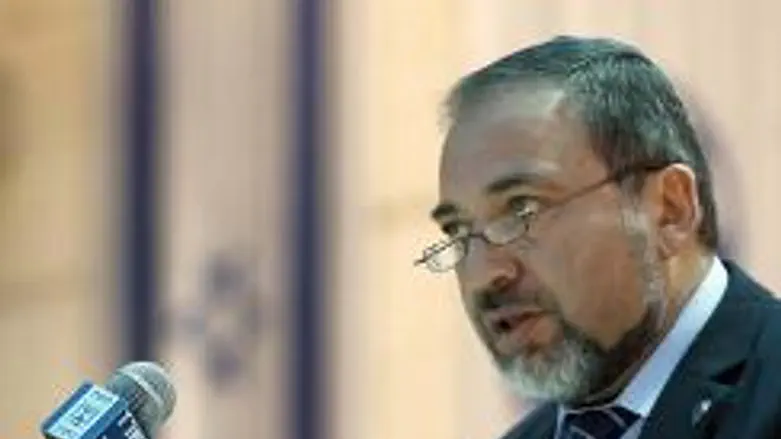
The EU-Israel Association Council held the first part of its ninth annual meeting Monday in Luxembourg. Foreign Minister Lieberman addressed the media alongside Jan Kohout, Deputy Prime Minister and Foreign Minister of the Czech Republic, which currently holds the EU Presidency, as well as EU External Relations Commissioner Benita Ferrero Waldner. The "constructive discussions," as Lieberman called them, marked 50 years of the establishment of diplomatic relations between Israel and the EU.
Following opening remarks by Foreign Minister Lieberman and Foreign Minister Kohout, Lieberman was pressed by reporters to discuss Prime Minister Binyamin Netanyahu's speech on Sunday in the context of EU relations.
"We have our position and we have the right to our position," Lieberman parried, "Every side has its position and Mr. Netanyahu was very clear about the Israeli position on talks with the Palestinians." He also made it clear that Israel is "ready for talks with every Arab country in our region." Israel, Lieberman said, will "support President Obama on regional peace, on the regional solution and the regional solution must include bilateral relations and bilateral talks among all the parties in the region."
The new Israeli administration's position, as expressed in the Netanyahu speech, was not a surprise, according to the Foreign Minister: "We said the same things before the elections, during the elections, and after the elections. Regardless of our position, we are open to any negotiations, we are open to dialogue and, as I mentioned, we are ready and we think that the solution must be the result of peaceful negotiations, and I think that we have a right to our position, at least as much as the other sides."
Regarding the EU position, which did not see Netanyahu's speech as conciliatory enough, Lieberman said, "We also expect the EU to encourage this dialogue between us and the Palestinians, to encourage and to support the open talks without any preconditions, and I think that it is really in our interest, in the interest of the Palestinians and, of course, in the interest of the EU that we reach a comprehensive solution in our region."
In his initial remarks to reporters, Czech Foreign Minister Kohout reiterated the European Union decision to freeze a plan to upgrade relations with Israel until the Jewish State submits to the establishment of an Arab state in Judea, Samaria and Gaza.
The EU position, Kohout said, "is still valid concerning the upgrade of the relations between Europe and Israel. We also stress the fact that the advancement of our mutual relations will take place within the context of our common interests, which include the two-state solution in the Israel Palestinian conflict, and the promotion of peace, stability and prosperity in the Middle East."
However, Kohout added, "the EU welcomes the initial step following the Israeli policy review announced by Prime Minister Netanyahu, of a commitment to a peace that will include the creation of a Palestinian State."
Iran is the Biggest Threat
Although not raised in their initial remarks, the issue of Iran was brought up by reporters. When asked what expectations Israel has from the EU in dealing with Iran, Foreign Minister Lieberman replied:
"I think that Iran is really the biggest threat, not only for the Middle East. But with regard to the Middle East; it is the biggest factor of instability. I think that the Iranian nuclear program could lead us into a really crazy nuclear arms race in our entire region and I don’t even want to think about what could happen in that case. I think that the international 
The Iranians are more dangerous than North Korea. community must stop the Iranian nuclear program with tough sanctions."
The difference between Iran and North Korea regarding nuclear weapons, Lieberman said, is that "the Iranians are more dangerous than North Korea. It must be immediate and I think that it is in the interest of all our neighbors, of the international community and of course, of Israel."
Asked about the elections and post-election violence in Iran over the weekend, the EU's Kohout said he was unable to comment. Foreign Minister Lieberman simply said, "We have never interfered in the internal affairs of any country and the elections and the demonstrations today in Teheran are their internal problem. Maybe it is a problem for the international community. We worry about their activity in the region. Their problems within their country are their problems."