

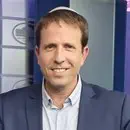
Former minister and chairman of the Reservists-Economic Party Yoaz Hendel narrowly missed entering the Knesset after his party received approximately 156,000 votes, about 30,000 short of the electoral threshold.
In an interview with Arutz Sheva-Israel National News, Hendel accepted responsibility for the disappointing result but insisted that Israel's political deadlock demonstrated the need for the third alternative he had offered voters.
"First of all, there is support. There are 155,000 people, a little more, who are saying, 'This is what we wanted,'" Hendel said.
"We didn't want to be with Bibi and the haredi parties that are passing a draft evasion law, and we didn't want to be with Eisenkot's bloc and the Arab parties."
Despite his disappointment, Hendel made clear that he had no intention of leaving politics.
"Obviously, there's a certain amount of frustration, but I deal with the cards I've been dealt. I'm a fighter. You don't abandon the battlefield just because the terrain isn't favorable right now."
Asked whether a campaign against his party on Election Day had contributed to its failure to cross the threshold, Hendel first took responsibility for the outcome.
"I'm responsible for everything. I'm responsible for establishing the party and for the political alliances. I'm the one who chose this path, who chose to lead this third way, this third bloc. And the results are on me, too."
Nevertheless, he argued that repeated claims that his party would fail to enter the Knesset had discouraged potential supporters.
"Throughout that day, there was a kind of influence operation, both in the media and on social networks. 'They're not going to make it, they're not going to make it.' That cost us seats."
Hendel reserved some of his strongest criticism for the parties in the opposition bloc, accusing them of abandoning their election promises concerning the drafting of haredi men into the IDF.
"What really bothers me is precisely those who made promises... I expected nothing from the coalition. For three years, they didn't help us fight on the battlefield. They prevented us from recruiting soldiers. We still don't have enough soldiers, even as we're sitting here right now. We don't have enough forces to cover the fronts in Lebanon, Gaza, Syria, and Judea and Samaria. We need more soldiers."
He expressed particular frustration over negotiations with United Torah Judaism shortly after the election.
"I can't understand it. We're only a few days after the election, and they're negotiating with parties that encourage draft evasion and call us a regime of heretics."
Hendel reiterated his opposition to forming a government dependent on Arab parties or haredi parties that reject the state's Zionist character.
"I declared and said that this was our mission: to establish only a Zionist government, without Arab parties and without haredi parties that treat the State of Israel as though we're a regime of heretics."
Despite holding Prime Minister Benjamin Netanyahu responsible for the October 7 massacre, Hendel argued that a government bringing together Netanyahu, Naftali Bennett, and Gadi Eisenkot could offer a solution to the political crisis.
"I'm still among those who hold Netanyahu responsible for October 7. The words 'I am responsible' mean something. I didn't want Netanyahu as Prime Minister. I said that. But I also said that a Zionist government must be established, and if Netanyahu, Eisenkot, and Bennett can sit together, that's the kind of Zionist government the State of Israel can sustain."
He urged political leaders to abandon their longstanding divisions rather than lead the country into another election.
"What I said was, stop obsessing over 'Anyone but Bibi,'" Hendel explained.
"I've personally experienced six election campaigns. In every one of those elections, the same process took place and we got the same result. What do they want now? A seventh election, so we can see it happen for the seventh time?"
Asked whether he would run again, Hendel confirmed that he intended to continue promoting a third political bloc if the current parties failed to form a Zionist government.
"If we reach another election and I haven't managed to bring about a Zionist government, then it's clear to me that this only proves we need to be very strong. I have to lead a third bloc that tells them: 'Are you crazy? Look, you've done this six times. Do you want it to happen a seventh time?'"
He also criticized the political rhetoric of both camps.
"Quite absurdly, it's always the 'Anyone but Bibi' bloc that ends up bringing Bibi back. And just as absurd are all these stories about a 'full-fledged right-wing government,' from the people who are now transferring 250 million shekels to Hamas, thinning out our forces, and giving up territory," he claimed.
"Maybe it's time for the Zionist forces to unite, because otherwise we'll look at this country and leave our children a state that's falling apart from within and unable to hold its fronts against external threats."
Turning to his party's failure to cross the electoral threshold, Hendel said an internal review was already underway to identify mistakes and prepare for future elections.
"Unlike the State of Israel and the Israeli government, the Reservists are establishing a party commission of inquiry. We don't have arguments about who the judge will be. We're examining, investigating, and conducting after-action reviews, just as I know from the military. We need to investigate our mistakes."
"Clearly, we need to learn and draw conclusions. That's what we're doing, and we'll come back more focused and stronger."
Hendel also spoke about the disappointment felt by his family, who had been actively involved in the campaign. His daughter serves in the IDF, while his younger son helped distribute campaign materials and participated in interviews.
"My immediate family was very involved in this election. They're all very disappointed, and they all share the same belief that we have to make sure we don't lose hope."
Reflecting on the sacrifices made by Israelis since October 7, Hendel said he had hoped the country would emerge from the war with a different political approach.
"We suffered the hardest blow in the history of the State of Israel. We're three years into the war. Everyone here has paid a heavy price, whether directly or through those close to them. Hundreds of days of reserve duty, wounded soldiers, people killed. I wanted to believe we weren't going back to where we were, that we'd learned something."
He concluded by reaffirming his commitment to overcoming the political deadlock.
"It's a long road, and sometimes it's complicated. But we cannot give up. We need to hold our heads high, look at reality, and understand that there's a real problem here, a political deadlock, exactly what we thought would happen."
"We intend to do everything possible to get the State of Israel out of this mess. This is our place. This is our home."